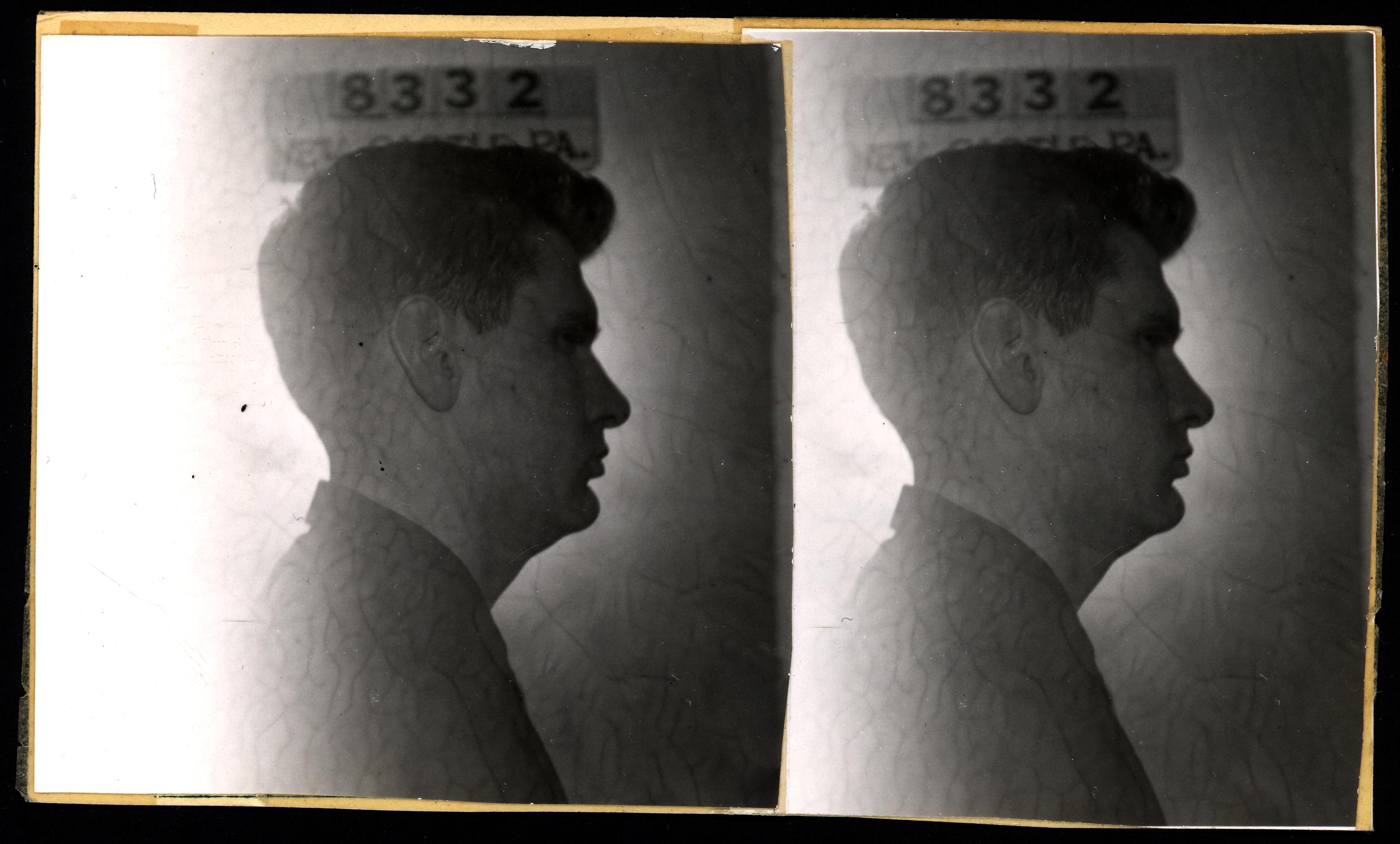
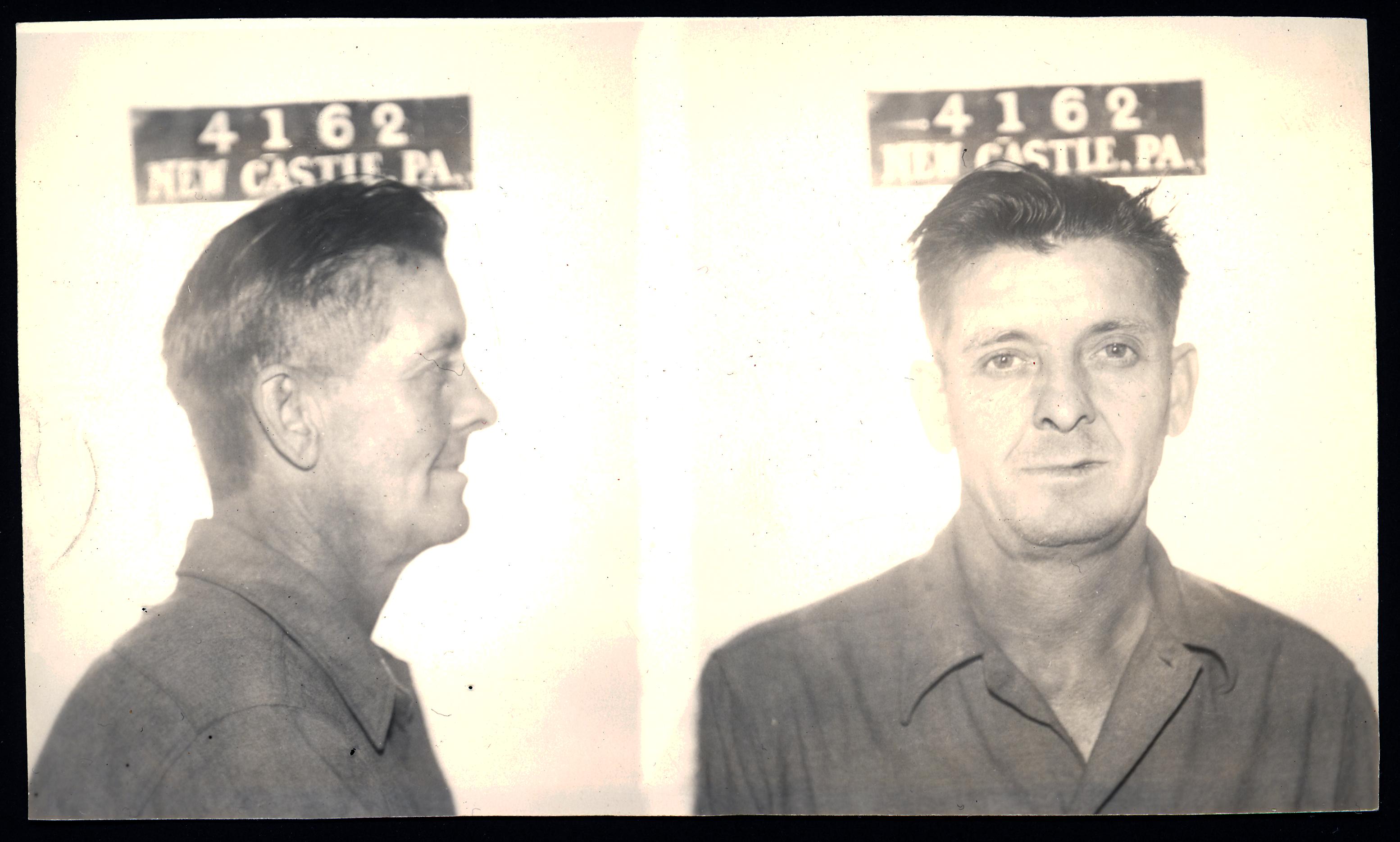
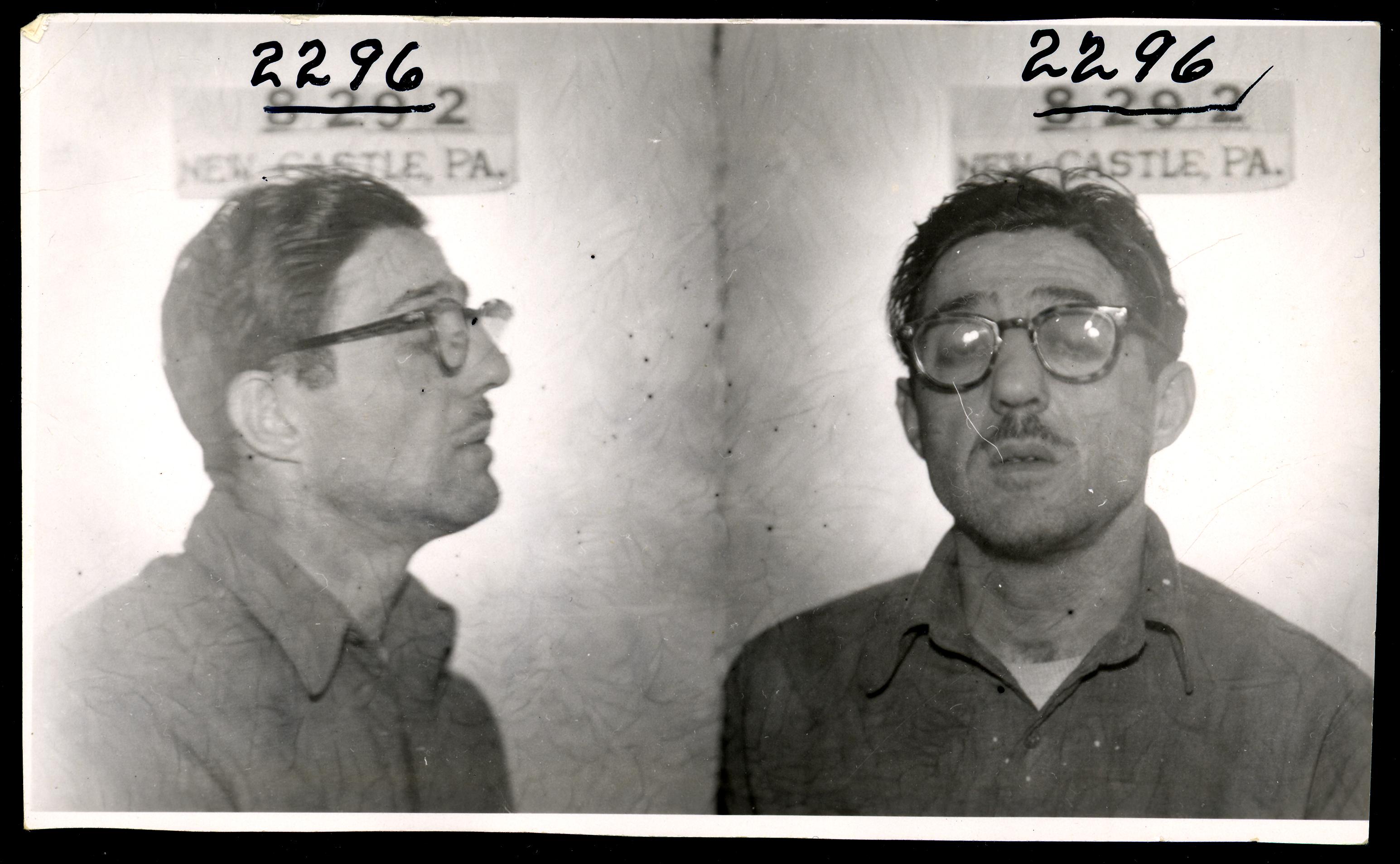
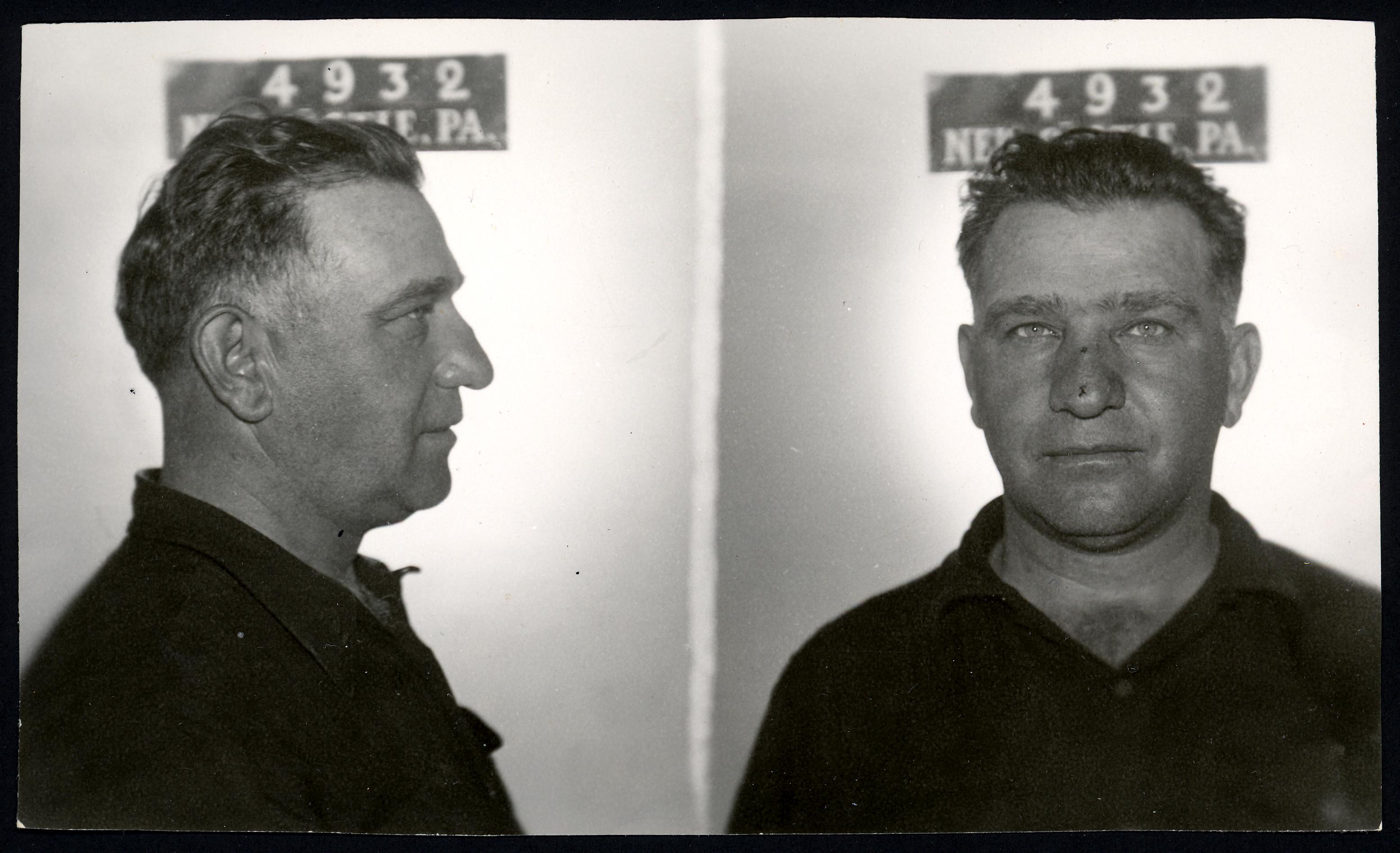
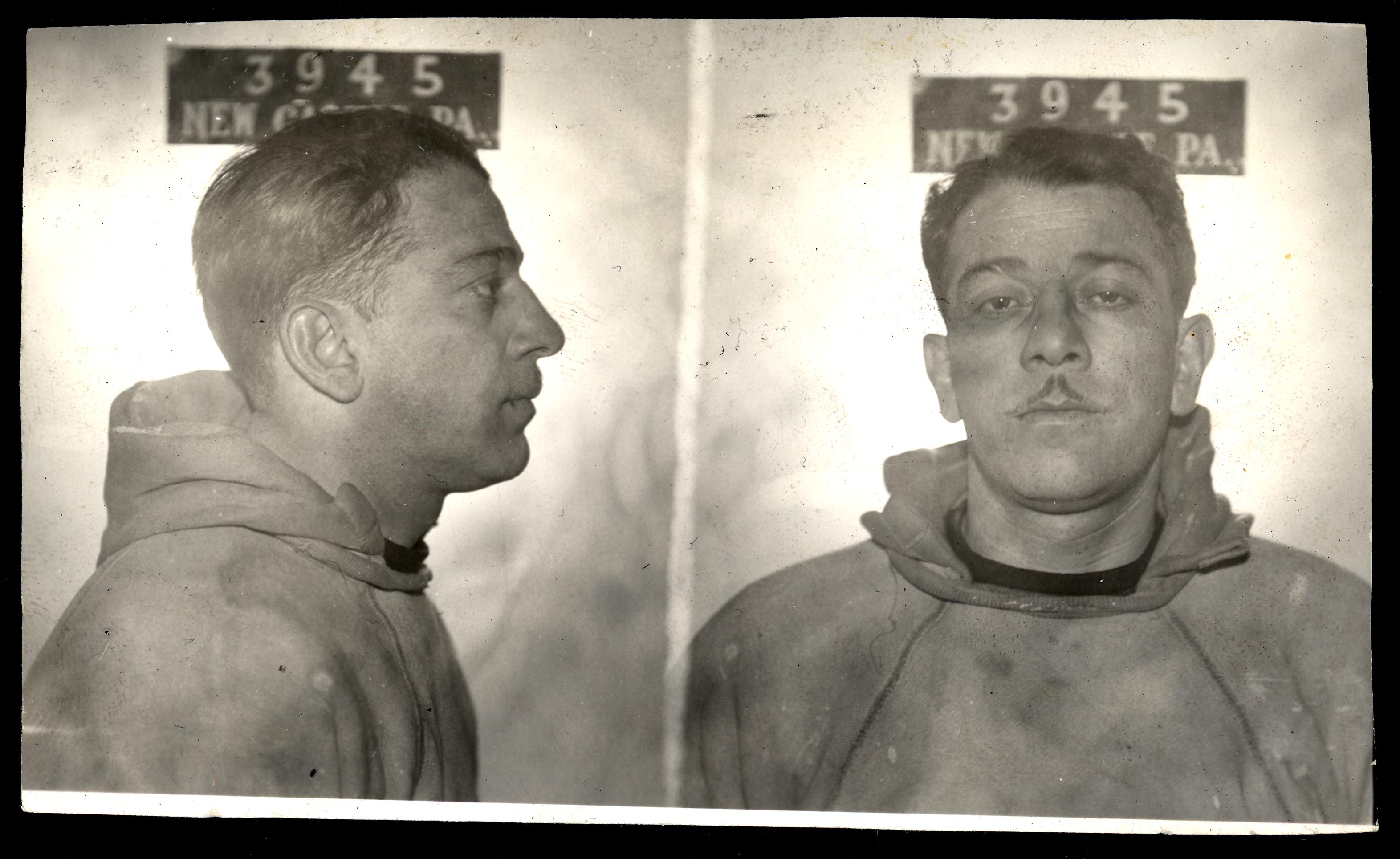
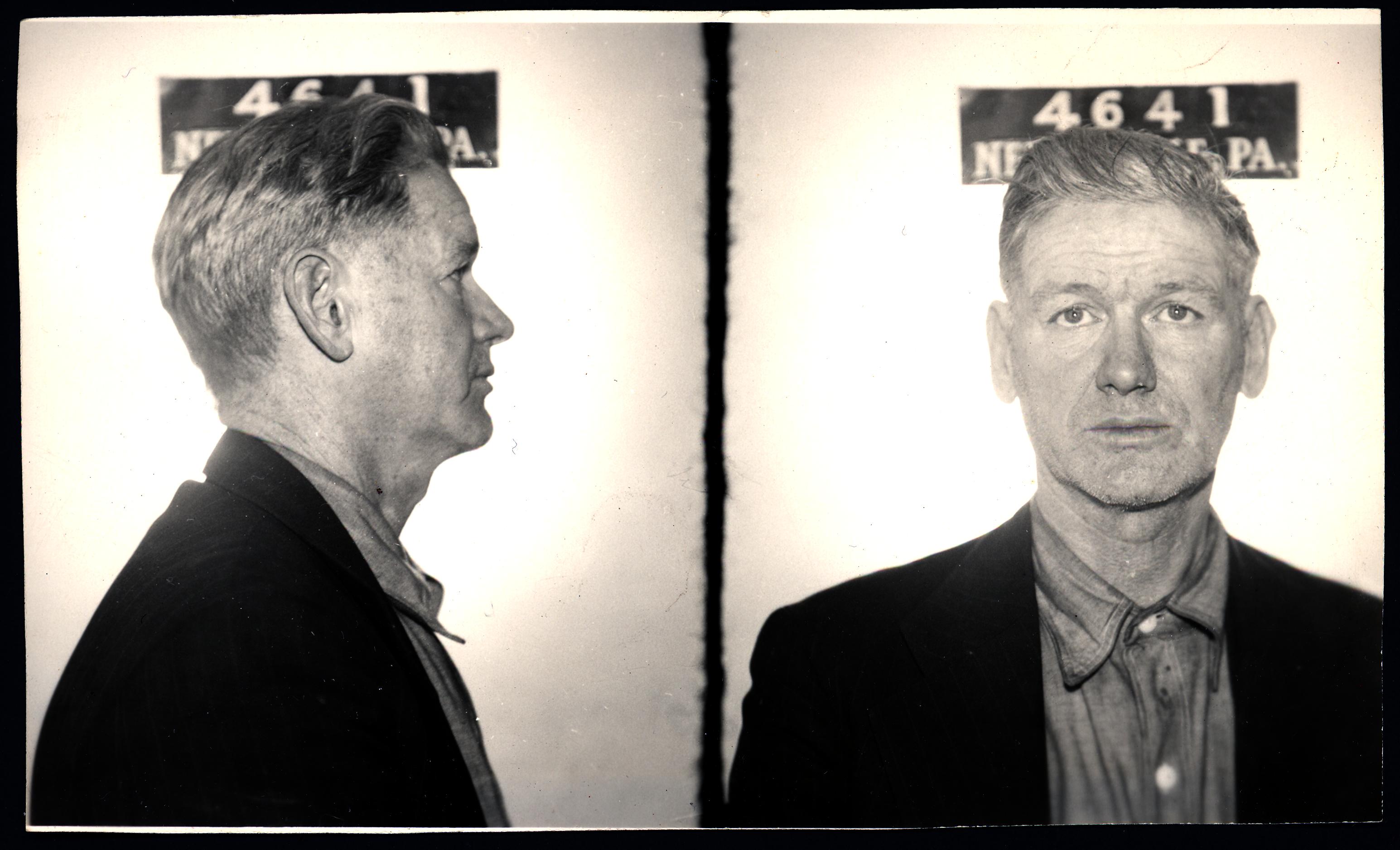
Charles M Stitt, “Burglary”, 10 October 1946

comments 6
Uncategorized

The guns of the USS Alabama, which fired more than a thousand rounds of sixteen-inch shells during the war in the Pacific, bombarding enemy-occupied islands in battles that resulted in the collapse of the Japanese military and the deaths of tens of thousands of soldiers and civilians, were kept in service for the last two years of the campaign by Charles Stitt, the descendant of a Scotch-Irish family who had opened a tailor’s shop in a log cabin a few miles north of New Castle in 1833.

On a Friday night in September, 1946, a year after the end of the war, Charles and three friends met a railroader from the Mahoningtown district named G W Dailey in a bar in downtown New Castle. They went with him by taxi to the neon-lit strip of Long avenue, where they kept drinking until around half-past two in the morning. Charles and his friends all lived in nearby streets, but they offered to walk with Dailey back towards the center of town.

Before they had gone more than a few blocks, the four men took Dailey to the rear of a building on South Jefferson street and attacked him. They stole his clothes and his cash and left him bleeding on the ground. Some time later, Dailey found a nightwatchman, who called the police. It took them a month to arrest Charles and the others. They all confessed to the crime. One of them handed over Dailey’s wallet. The case never came to trial.

Charles spent the next forty years manufacturing machine parts, mostly in the NRM plant in Columbiana, Ohio. He died in New Castle in 2006, at the age of eighty-one.

Sources: New Castle News (27 Jan 1945 “Cpl C Critchlow Home From The Pacific”; 10 Oct 1946 “Police Arrest Four In Holdup September 14”)

Ernest Smith Jr, “OMVWI”, 25 March 1956

comments 3
Uncategorized

Ernest wasn’t long out of the navy when, on a wet and windy night, he was caught driving a car while drunk (fine: $100). The year before, he been honourably discharged after having served five years on the USS Laffey, which had been involved in heavy fighting while taking part in the blockade of North Korean ports.

The USS Laffey’s Class of ’52 yearbook, a souvenir booklet produced by the ship’s crew in their free time, contains an unidentified sailor’s recollection of a battle that Ernest would have been part of:

“You could hear the dull water-deadened thud of concussion against the bulkheads below the water line during the battle … There was a gnawing uneasiness in the pit of every stomach and a tendency to want to see what was going on in spite of the fact that it was raining shrapnel on all exposed decks. They lost the windshield on the bridge, a bit of jagged steel missing the captain by inches. On all sides there was almost constantly a geyser of water from the bracketing shells and yet no one who was on the ship that day will ever forget the teamwork in the common defense that the entire crew displayed.

“In the 28 days in Wonsan harbor, we fired 5,657 rounds of five inch ammunition and many of the dug-in batteries fired at us only long enough to let our sharp-eyed lookouts spot them and then they were silenced.

“It was a fitting record for a proud fighting ship to add to a previous outstanding record in World War II.”

Ernest is in the centre of the front row in this picture from the yearbook:

Sources: USS Laffey Class of ’52 yearbook.

James Lane, “Stat Rape”, 10 June 1947

comments 4
Uncategorized

James and his brother Lee were arrested for the statutory rape of a fifteen year old girl, which occurred on June 9, 1947, and dates prior. James, who was twenty-two, was fined $100 and given six months in the Lawrence County jail; Lee got off with only an $80 fine or forty-five days in jail.

The brothers appeared in court regularly throughout the forties and fifties. A few years before the statutory rape charge, Lee had been fined for following a couple down Moravia street with a knife in his hand and, a few years later, both were back in court on a highway robbery charge involving an attack on a labourer called Leo Kennedy, who had been walking down South Jefferson street just after midnight when James and Lee grabbed him and dragged him into a side street. One of them rabbit punched him, and he fell to the ground. When Lee took his wallet, with $42 inside, Kennedy told him, “I’ll know you,” and Lee kicked him in the teeth.

The police recognised the Lane boys from Kennedy’s description – they knew the brothers well – and sent four officers to raid their house. Lee tried to escape, but was caught at the front door, and James was found in the kitchen. They spent nearly a year in jail before their trial, at which they were found guilty and each fined 5-and-a-quarter cents (a strange sum; presumably there was a statutory requirement for at least a nominal fine) and sentenced to one to two years in the county jail.

A few years after that stretch, in 1955, James and Lee were jailed again for stabbing two other men in a Saturday night fight in George’s Lunch on West Washington street.

That seems to have been Lee’s last arrest. James still had one more to go.

On the morning of August 20, 1962, six miles west of Hancock, Maryland, a car driven by James pulled over at a telephone box beside Hoffman’s Inn on route 40. He and his friend, Robert Booker, were driving a third man, Lawrence Johns, to Washington, where he was going to hide out after pulling a $10,000 savings-and-loan robbery.

Johns obviously wasn’t sharing his loot with his drivers, as it seems that James and his friend were financing their trip by stealing coin boxes from pay phones along their route. They’d already robbed two that day – scoring $19.20 in small change from one of them – and were trying for a third, working busily with screwdrivers and crowbars, when a police car came up the road towards them. Johns ran out of sight, leaving James and Booker to surrender. The policeman, Corporal Robert Kirby, cuffed the pair, and was about to put them in his car when Johns came out of hiding and shot him down.

James later said, “I ducked when the shooting started, and I grabbed the car so tight with my free hand that I cut two fingers.” When he found the courage to check what had happened, he saw that Johns had run off, and that Corporal Kirby, although wounded in the hip and shoulder, was still alive and had his gun trained on him and Booker.

Kirby kept them prisoner until more cops arrived. A manhunt was organised to search nearby Sideling hill for Johns, who shot himself in the head when they caught up with him the next day. Or so we’re told.

James and Booker were found guilty of attempted larceny and of being rogues and vagabonds – a rare charge arising from the fact that they were officially of no fixed abode when they committed a crime on the highway – and were sent to the Maryland house of correction for two years. While there, they were found guilty of robbing the other telephone boxes, and were sentenced to another year, to be served after their first sentences.

James turned 40 in jail. When he got out, he returned to New Castle, but he’d only been home for a few years when, in the spring of 1972, he fell ill and died in hospital at the age of 47.

Sources: New Castle News (11 Jul 1947 “Held For Hearing”; 2 Oct 1947 “Sentences Passed”; 12 Aug 1950 “Highway Robbery Charge Against Two”; 14 Sep 1950 “Lee Lane and James Lane convicted with robbery”; 19 Dec 1955 “Two Jailed On Assault Charges”; 1 Jan 1962 “Phone Looter Connected To Big Robbery”; 12 Oct 1962 “Two Are Sentenced in Wounding of Maryland Trooper”; 18 April 1972 “Deaths Of The Day”);  Daily Mail, Md, 13 Sep 1962 “Friends Of Man Who Shot Kirby Indicted Today”; Morning Herald, Md, “Companions Of Johns Guilty On Two Charges”.

Loyes Langdoff, “Drunk & Disorderly”, 2 March 1940

Leave a comment
Uncategorized

The wet spring weekend in 1940 during which Loyes Langdoff was arrested for being drunk and disorderly was an extraordinarily quiet one for the town, and only one crime story appeared in the New Castle News of Monday, 4 March:

“REPORT COAT STOLEN — Detectives were summoned to the Strouss-Hirshberg store, Saturday afternoon, it having been reported that someone had stolen a woman’s blue Chlnelle coat, worth $39.95.”

Detectives Moore and Young were assigned to solve the robbery. They appear never to have done so.

The heavy rains over the weekend melted the last snow that had lingered since winter, but evidently dampened spirits in town. However, a report was made to the paper that, on that gloomy Saturday afternoon, some “beautiful blooming Amaryllis lilies of a salmon hue” and a red begonia had been observed in the front window of a home on Wilson avenue, which cheered the passerby who saw them, but caused a journalist to reflect, “Years ago, blooming plants in the windows of homes could be seen quite often this time of the year, but for some reason this custom has gone into relapse.”

Sources: New Castle News 4 March 1940.

Frank Wilson, “Disorderly Conduct”, 5 Oct 1940

Leave a comment
Uncategorized

Frank Wilson’s arrest on a charge of disorderly conduct didn’t make the New Castle News, even though it had been a slow weekend.

The day he was arrested, Saturday, 5 October, 1940, began with the discovery of a crime at Keefe’s Cafe, on South Mill street. Some time before the cafe opened up, a thief had smashed the glass in the ventilator in the door, squeezed in through the small opening, stolen $57 in cash and $192 in endorsed cheques, and left via the rear door.

It was the biggest crime of the day, but the culprit would never be apprehended, although the police couldn’t have known that at the time.

That afternoon, a lesser crime occurred over on the east side. The proprietor of a grocery store there noticed that a group of local boys seemed to be coming into his shop rather more frequently than usual with empty gallon and half-gallon cider and vinegar bottles, for which he would give them money or fruit. Growing suspicious, he checked the bottles carefully and realised that they were his own — the boys were carrying them out of his backyard and selling them back to him. The shopkeeper, perhaps feeling embarrassed at having been so green as to have fallen for such a scam, settled for yelling at the boys rather than getting the police involved.

That night, presumably around the time Frank was getting arrested, someone broke into Andy Skiba’s car on Long avenue and stole a red dress, a blue dress, a white shirt and a neck-tie, and someone else stole Norman Stoner’s bicycle on East Washington street.

It was such a quiet weekend that there was even room for a story about the doings of the local insects: “During these cool mornings, some flies go in to one of the local stores to ‘get their feet warm’. In there is a box-like apparatus, with electric bulbs within, covered with a metal plate, for the purpose of drying Photo prints. The flies have located the warm spot and make use of it. Incidentally they also torment the operator with their attentions.”

The front page of the paper was filled with stories about German attacks on Britain, and the only picture is of a mass of Londoners sheltering from a bombing raid in an underground station. America’s first ever peacetime conscription had just begun. Within a month, 75,000 young men would be in uniform and, in just over a year, America would be at war with Germany and Japan.

Sources:New Castle News, 7 Oct 1940

Louis W DeLuria, “OMVWI”, 2 Jan 1956

Leave a comment
Uncategorized

Between July and November, 1936, Louis Deluria broke into the Lewis confectionery, the Lief saloon, the Davis Tydol garage and the Shaffer & Snyder drug store, all on the south side, within a few blocks of his home. He stole razor blades, gum and cough drops from the confectionery; liquor, cigars and a peanut machine from the saloon; oil and a battery from the gas station; and compacts, cigarettes and candy from the drug store.

He lost a button from his overcoat when it caught on the drug store’s rear screen door. Detectives found it the next morning. They took it around clothing stores in town, asking who had bought the kind of coat it came off. Louis was arrested by sundown.

Louis’ mug shot lay on file for twenty years, until the first Monday in 1956, when it was replaced by one that was taken after he crashed his car into two parked cars on West Washington street. He was fined for operating a motor vehicle while intoxicated.

Louis moved to Florida the following year. In 1966, he joined a committee that organised a picnic for two hundred and sixty-six former New Castle families who had settled there. On the twenty-second of October, more than six hundred people turned up at East Greynolds park, outside Miami, in the hope of finding someone they knew or who might remember their families. There were games and a barbecue. The Mayor of Miami presented a proclamation. Awards were given out to the earliest settler, the newest settler, the oldest woman and the largest family (ten children). It rained for much of the day. The banners above the entrance to the park and the bumper plates on the cars read, “We’re from New Castle, PA, and Proud of it.”

Things went pretty well. A “New Castle day in Florida” picnic was held every year for the rest of the sixties.

There is no further record of Louis’ life until his death at the age of 81, in 1995.

Sources: New Castle News (July 22 1936, “South Side Store Robbed Last Night”; November 23, 1936, “Two Business Places Robbed”; November 24, 1936, “Police Arrest youth For Local Robberies”; November 25, 1936, “Deluria Enters Plea Of Guilty”; January 3, 1956, “Charge Tipsy Driving”; September 6, 1966, “Old Friends Meet On New Castle Day”).

Gerald A Schooley, “Arson, Burglary”, 5 July 1940

comments 2
Uncategorized

Before the sale of fireworks was banned in Pennsylvania, as many as six people in the state had been killed by fireworks every 4th of July. By 1940, the second year of the ban, no one had. Firework injuries for the holiday were down from more than three thousand to fewer than a hundred. The state medical society, the fire departments and the police were happy, but others, nineteen-year-old Gerald Schooley among them, missed the excitement.

In the early hours of the morning, after a 4th of July evening spent drinking beer with his friends in the quiet streets downtown, Gerald set off on the long walk back to his home on Park avenue on the north hill. By two, he had reached Wallace avenue, a few blocks from his house, where it occurred to him to set off a fire alarm box. Minutes later, a fire truck arrived. When it was clear that there had been a false alarm, it drove back to town.

Not long after the fire truck had left, Mont Johnson of Reis street thought he heard someone doing something to his car, which was parked outside his house. As he went outside, he saw a young man in white pants running off up an alley. Mysteriously, on the floor of his car was a pile of torn papers. Shortly after, Joseph McIlvenny of Boyles avenue, who had been awakened by the false alarm, looked out of his window and saw someone wearing white pants striking matches outside his garage. He called out, and the figure ran away. Around the same time, E A Long, also of Boyles avenue, was woken up by his wife, who had heard a strange noise outside. He turned the light on and saw a man run out of the alley behind his house. Long’s car appeared to have been pushed halfway out of his garage.

At a quarter past three, Leonard Peterson of Wallace avenue raised an alarm—the garage behind his house was on fire. The fire truck returned. The captain of the fire department called the police to say that the fire seemed to have been deliberately started inside one of the two cars in the garage. The police sent a couple of cruisers up to patrol the area. Not long after they arrived, a call came through that garage in the rear of Boyles avenue was also on fire. Inside were two more cars, which were already totally destroyed. Before the firemen could get over there, they heard that another car, parked in front of a house on Boyles avenue, had burst into flames.

Two policemen who were standing on Boyles avenue, helplessly watching the burning car, heard someone running through the bushes in a nearby garden. They followed the noise and saw a young man, dressed in a spotted shirt and white pants, running into 312 Park avenue, just around the corner. Gerald had finally made it home, but he wasn’t allowed to stay there for long.

At first, he denied all knowledge of the fires, but by the time that Chief of Police McMullen came down to see him at city hall at half past five that morning, he had admitted that he had started them, although, he insisted, by accident.

Gerald told the police that he had only been trying to smoke a cigarette in peace. He said that, on his walk home, he had realised that he had no matches and had looked in parked cars until he found some, but that, every time he stopped to light his cigarette, someone yelled at him and made him drop his match. He said it was possible that those matches could have fallen on pieces of paper that might have fallen out of his pockets when he took out his cigarettes, and that might have started the fires.

The judge set bail at $3,000, which Gerald’s parents paid. When the case came up in October that year, Gerald pled no contest to charges of arson. He was fined $825 to make good the damage he had caused and given a two-year suspended sentence.

Before those two years were up, the Japanese had bombed Pearl harbor and Private Gerald Schooley was in an army training camp. He survived the war and came home unharmed. He moved to Youngstown, where he died in November 2005, at the age of eighty-five.

Sources: New Castle News (3 July 3 1940, “Quiet Fourth For New Castle”; 5 July 1940, “Firebug On North Hill; Autos Burned”; 11 July 1940, “Schooley Is Held For September Court”; 21 Oct 1940, “Court Report”; 18 Sep 1943, “In US Armed Service”).

Andrew Masters, "Intox Driver", 25 April 1948

comments 2
Uncategorized

Just before midnight on 25th April 1948, Officer George Sigler saw a car smash into a parked car on South Mill street and weave on down the road. He caught up with it on Moravia street and arrested the driver, Andrew Masters, who was drunk and bleeding from the nose. Andrew was given the usual sentence of thirty days in the county jail, out in three if he paid the $100 fine and costs.

A decade later, when Andrew was fifty-eight, he was working as a conductor on a Pennsylvania Railroad train that was making its way from Toledo to Canton, Ohio, when it ran into the biggest storm to hit the county all year, which had blacked out neighbourhoods, flooded roads and houses and brought down telegraph wires. Just outside North Lawrence, a few miles before Canton, one of the carriages of Andrew’s train came off the rails, dragging with it seven other carriages, five box cars and three gondolas and tearing up two main lines. No one was killed, but Andrew was injured so badly that he was left disabled and unable to work.

A Youngstown attorney, John Ruffalo Jr, called on Andrew. He told him that the accident that had crippled him had had little to do with the storm that night and everything to do with negligence on the part of the railroad. The carriage had derailed because a fire had started in a poorly maintained part of the wheel mechanism and burned through an axle. Ruffalo specialised in that kind of case. He assured Andrew that he would get him a big settlement. He had taken on the railroads dozens of times on behalf of workers who had been injured and incapacitated due to the companies’ negligence—his most recent case had secured $112,000 compensation from the Baltimore & Ohio Railroad for a railwayman who had lost both legs in a work accident (find more information on the issue at https://www.bruninglegal.com/legal-services/). He told Andrew to expect a $150,000 settlement.

The case took two years to come to court. After a week-long hearing, the jury upheld Andrew’s claim—the Pennsylvania Railroad had been responsible for the derailment and, therefore, his injury. However, they awarded him only $8,500. Andrew wanted to appeal, but Ruffalo told him that it wasn’t worth it, that he should walk away. Andrew was furious, but there was nothing he could do.

Two years later, in 1962, Andrew was contacted by investigators working for the Baltimore & Ohio Railroad and the American Association of Railroads. The railroad companies had tired of Ruffalo’s negligence cases and were digging around for something they could use to get him disbarred. They had already discovered that Ruffalo had been paying a railroad brakeman named Michael Orlando to act as an undercover agent to solicit and investigate cases that he could profitably prosecute. That was probably good enough to have him struck off, but they wanted a better case.

Andrew felt that Ruffalo had let him down badly, and was glad to help. When the investigators asked if Ruffalo had ever given Andrew money during the court case, he said that he had. Andrew had been out of work and had often had no money to live on. When that happened, Ruffalo had loaned him cash to tide him over, with the promise that he would be paid back when the case was won.

The investigators told Andrew that, although that might seem a reasonable thing for a lawyer to do when dealing with a penniless client, the bar’s ethics committee viewed it as buying an interest in a case, which was strictly forbidden. Andrew agreed to testify at a hearing in Youngstown, along with other former clients of Ruffalo’s who had also borrowed money from him but had been disappointed at the outcome of their cases.

A month before the hearing, just before Christmas, 1962, Andrew’s friend, Angelo Medura, dropped in for a visit. He explained that he had a chance of opening a bar, and that Ruffalo was going to back him in the deal. However, if Ruffalo got disbarred, the deal would fall through. He said, “Andy, what are you going to gain by going over to Youngstown to hurt this man?” Then, to cement the appeal to his conscience, he offered him $300.

Medura was an agent of Ruffalo’s and had visited all the former clients, offering cash—and, in one case, a bottle of whisky—if they failed appear in court. Andrew guessed as much, but didn’t blame him. He didn’t know what to do. He wanted to help Medura get the bar and he wanted the $300, but he still wanted to get back at Ruffalo.

The day after the hearing began, a representative of the American Association of Railroads took Andrew to lunch to talk about his dilemma. There is no record of exactly what was discussed, but the result was that Andrew decided to testify and, six months later, Ruffalo was disbarred due to professional misconduct. Andrew may have felt some degree of satisfaction. The train companies most certainly did.

Andrew died in October 1976, at the age of seventy-eight.

Sources: New Castle News (Driver Is Held” April 26, 1948; “Andrew Masters Wins Verdict” Nov 10, 1960); Massilon Evening Independent (“School Hit By Lightning” May 11, 1957); Zanesville Times Recorder (“Traffic Restored After Wreck” May 11, 1957); McKean County Democrat (“John Ruffalo, Prominent Lawyer, Dies In Hospital” Feb 12, 1953). Details of proceedings against Ruffalo are from http://altlaw.org/v1/cases/850190.

Joseph Augostine, "Dis Conduct", 15 Feb 1943

comments 2
Uncategorized

Joseph Augostine, a house painter, was arrested for disorderly conduct in February 1943, one week before Chief of Police Willis McMullen announced that New Castle would no longer tolerate such behaviour and ordered city policemen to clear all undesirables from the streets. McMullen told the press, “With the good boys of the community fighting for their lives, others sweating in vital industrial concerns to furnish war material and their elders engaged in various war activities, I see no reason for hoodlums, loiterers, slackers or prostitutes.”

The night before he made his statement, McMullen had seen a drunk dressed as a sailor standing on the corner of Croton avenue and East Washington street and challenging passers-by to a fight. McMullen arrested the man, and was appalled to discover that he had been deferred from service due to a physical ailment and had no right to wear any military uniform. “Police will visit cafes or any other place where they may suspect there are hoodlums, loafers, prostitutes or a person they have reason to believe has not complied with the selective service law. The loiterers and non-producers will be asked to explain how they earn a livelihood,” he said.

The chief pointed out that as many as five hundred workers slept in one central business section of the city and that loud juke boxes and disorderly conduct could not be permitted. “Workers need their rest,” he said. “Night carousing on the streets is out for the duration.”

On the day of Joseph’s arrest, Mrs Frank Mastren, of Dushane street, heard that her brother, Edwin Isaac, an aeroplane gunner fighting in North Africa, had been seriously wounded during a raid. The month before, he had made the front page of the New Castle News under the headline, “New Castle Gunner Downs Axis Plane In Tunisia Battle”. Everyone had been very proud. A war telegram was also received by Mr and Mrs John Dout, of Etna street, which informed them that their nineteen-year-old son, Morris, had been killed by an accidental shell explosion at his training camp in North Carolina. It had been only two months since he’d left his job at Shenango Pottery to enlist. Such stories were already so common that each merited only a short paragraph in the paper.

Following a night in the cells, Joseph received a fine of $10 and was released.

Joseph’s three older brothers were already in uniform and would go on to fight in Sicily, Anzio and Normandy—from where one of them, Edward, would send home packages containing German helmets and other items taken from the bodies of dead soldiers—but Joseph avoided the draft for so long that the war was virtually over by the time he completed basic training.

After the war, Joseph worked as a gardener and groundskeeper for a while before opening a garage in Hillsville, where he ran a few illegal slot machines as a sideline. He died in August 1992, at the age of eighty-two.

Sources: New Castle News (23 Feb 1943,“Police Chief Orders Cleanup Of City”;16 Nov 1944, “Sgt Augostine Sends Souvenirs”; 29 Dec 1944, “Raymond Augostine Is Home From Overseas”; Feb 15 1946 “New Castle Gunner Downs Axis Plane In Tunisia Battle”, “Edwin R Isaac Wounded In Raid”, “Injuries Fatal To Local Marine”; 4 Oct 1956 “Allow DA To Wreck Gambling Machines”).

Walter Jamison, "Forgery", 24 October 1946

Leave a comment
Uncategorized

A wealthy north hill citizen named W S Harlan returned home just after dark one December night in 1906 to discover a gang of burglars in his hallway. They were armed with blackjacks and pistols, but Harlan overpowered one of them and kept him captive while the others ran off. The burglar was fifteen years old, the son of a prominent north hill family. He confessed to other recent burglaries and named his accomplices, a group of boys who were also from respected families in the area. To shield the parents, Harlan declined to press charges and the police and the district attorney refused to release the names of the boys. The letters of outrage that were published in the town’s papers and the complaints of those who said that there was one law for the rich and another for the poor were ignored.

Ten days later, Walter Jamison—then just sixteen years old—and three younger friends, all from the poor district of Mahoningtown, robbed the Patterson & Sample store of several pistols, knives and boxes of cartridges, which Walter sold to railroad men around New Castle junction. They were caught soon after and admitted the crime, the younger ones in tears. They said that they admired the north hill gang and had been encouraged by their light treatment. After letting the well-connected boys off, the court had no option but to do the same with the Mahoningtown boys. The judge gave them suspended sentences, saying, “My decision will be criticised by some people. It is up to you, boys, to so conduct yourselves, that this criticism will be shown to have been unwarranted.”

Walter’s friends did what the judge asked and avoided trouble with the law for the rest of their lives. Walter did not. He and another friend were arrested three years later for passing forged cheques in New Castle, Youngstown and Erie for sums of between $7.50 and $18.40. Walter had signed them, variously, “BD Wilson, superintendent of the Youngstown Foundry company”, “EJ Wilson, secretary of the Youngstown Foundry company”, “AC Dickson, secretary, Youngstown Foundry Co” and “HB McClurg”. Walter’s friend, a first-time offender, was given a suspended sentence, “so that he will have to go straight in future”, but Walter was jailed. After he was released, he stole a horse and buggy from a livery stable in New Castle and vanished from town.

Walter remained at large for five years, until he returned to New Castle in the summer of 1921 and was arrested for passing a forged cheque. He received sentences of two years for forgery and three-and-a-half years for horse theft. (The policeman who arrested him received a reward of $20 under an old Pennsylvania horse-theft law.) He was released in the middle of the 1920s, but was arrested in Mercer County in 1927 on a charge of forgery and sent to the Allegheny workhouse. Walter spent the rest of the 1920s being moved from jail to jail, as detectives in various jurisdictions connected him to an ever-growing number of open forgery cases.

As the new decade began, Walter was doing time in the Ohio state penitentiary in Columbus. He worked in the prison kitchen and had become popular among the inmates and guards on account of the quality of his doughnuts—he oversaw the production of nine thousand a day, and was known as the best doughnut baker ever to have been incarcerated in the prison. On 30th June 1930, a new guard gave him permission to step outside for a minute to get a bottle of milk from the dairy across the street. He walked out of the gate and didn’t come back.

Walter fled across Ohio in the direction of New Castle, swindling grocery stores out of several thousand dollars-worth of goods, which he paid for with bad cheques in the name of a cashier of the Baltimore and Ohio railroad. (He bought a rubber stamp with the name of the railroad on it to give his forgeries a degree more plausibility.) Railroad detectives followed the trail of cheques from town to town, comparing the signatures on them with the signatures in the registers of cheap boarding houses until they found a match. Two months after Walter escaped from prison, he was captured as he slept in his room in the Ohio hotel in Akron.

He was free by 1935, when businesses in the Youngstown area were warned that “Walter Jamison, a jailbird” was distributing forged cheques from the Standard Slag co. A decade later, in 1946, he was arrested in New Castle on a charge of uttering a forged instrument and was given a two-year sentence. He was fifty-six years old. There is no further record of him.

Sources: New Castle News (17 Dec 1906, “Boy Burglar Was Caught In Harlan Home”; 30 Jan 1907, “Pleaded Guilty And Were Held For Court”; 18 Dec 1906, “Injustice Done By Lienency (sic) In Behalf Of Boys”; 20 Dec 1906, “Boy Burglary Affair Is Up To District Attorney”; 21 Dec 1906, “PJ Watson Suggests Other Phases Of The Boy Burglary Hush-up”; 18 Jan 1907, “Mahoningtown Lads Emulated Nth Hill Boys”; 6 Feb 1907, “Sentence Was Suspended On The Boy Burglars”; 15 Feb 1911, “Easy Kale For Boy Forgers”; 30 Sep 1921, “Jamison Sentenced To Penitentiary”; 15 May 1925, “Arrest Man With New Castle Checks”; 8 June 1927, “True Bills Found By Grand Jury In All But Two Cases”; 10 Oct 1928, “Workhouse Prisoner To be Re-Arrested”; 14 Aug 1930, “Walter Jamison Is Recaptured”; 15 Aug 1930, “Jamison Back In Ohio Prison After Recapture; Prisoners Are Gratified”; 24 Oct 1946, “Worthless Check Charge”); Youngstown Vindicator, 4 Jun 1935, “Check Slicker At Large”; The Border Cities Star, 5 Sep 1930, “No Doughnuts”.