

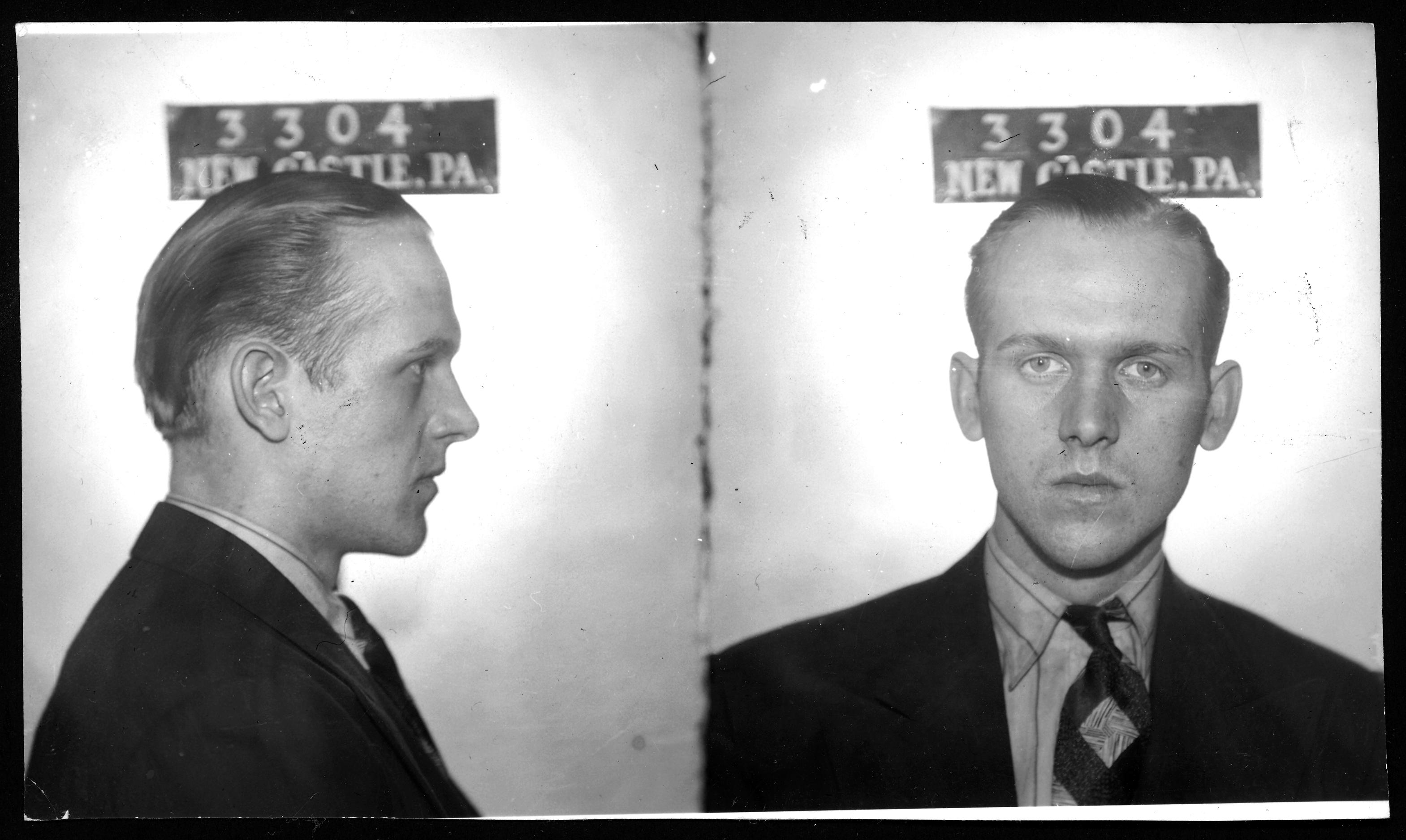
Edward Scales was arrested and photographed as a suspect in a hold-up that took place a few days before Christmas in 1934. He was released without charge but enjoyed only a month of freedom before returning to jail when a bank robbery that he had been planning for months went badly wrong.
Edward had a long association with the New Castle police, to whom he was better known by his street name, Jack of Diamonds. He ran gambling joints and unlicensed Negro clubs on the south side before the first world war. In 1921, to avoid jail, he assisted prohibition agents in a bootlegging case by buying a $1.25 bottle of raisin jack from a speakeasy run by a man named Nicholas Chikota and taking it to the district attorney, who used it as justification for a raid. After Edward testified at Chikota’s trial, the DA acknowledged that, although it was unfortunate that the state had had to rely on such a disreputable character, it was impossible not to. “I cannot go to the speakeasies to secure evidence,” he told the jury. “And neither can the county detective, as they would immediately become dry at our approach. It often happens that the only ones who can secure the evidence have been law breakers themselves.”
The jury accepted Edward’s testimony, and found Chikota guilty.
Edward’s co-operation with the law gave him no immunity from police interference in his business, and he was fined several times in the years following the trial for allowing “African golf”—dice games, such as craps—to be played on his premises.
In 1925, during a quarrel over a woman, Edward pulled out a pistol and shot at a man named Ben Higgins, who collapsed and was taken to hospital. He died ten days later. Edward was charged with murder and held in jail for three months until the date of his trial. A conviction seemed certain until the doctors who examined Higgins’s body told the court that Higgins died of pneumonia and pleurisy and that his body showed no signs of ever having been shot. None of Edward’s bullets had hit their target. Higgins had merely passed out from fright when Edward fired at him, and his death the following week had been unrelated to the events of that day, a fact of which the prosecution had been unaware until the day of the trial. The judge instructed the jury to return a verdict of not guilty, and Edward was released.
Edward stayed away from the courts until 1931, when he “attempted to seduce” Eleanor Wagner, a ten-year-old girl who lived on Mahoning avenue, and was given a two-to-four year sentence for assault and battery with intent to commit rape.
Edward turned forty in jail. After his release, he did some numbers running and got a job in a saloon in Youngstown, where he met a middle-aged Lawrence county businessman and poultry fancier, Homer Chrisner, who planned the disastrous bank raid that led him straight back to jail.
Homer Chrisner’s mug shot and the conclusion of Edward’s story are here.
Sources: New Castle News (17 June 1921, “District Attorney’s Table Is Decorated With Booze Bottles”; 22 June 1922, “Muse Appeals To Jury To Stand For Law And Order In Liquor Case”; 26 March 1923, “Arrest Eight For Shooting Craps”; 9 Sep 1924, “Negro House Raided By City Officers” 11 Oct 1924, “Turned Over To Alderman Hamilton”; 22 Aug 1925, stub; 6 Nov 1925, “Judge McLaughry Halts Murder Trial, Frees Prisoner”; 13 July 1931, “Colored Man Arrested”; 22 Sep 1931, “Convict Scales In A Few Minutes”; 2 Oct 1931, “Prisoners Are Sentenced For Various Crimes”).





 Small Town Noir