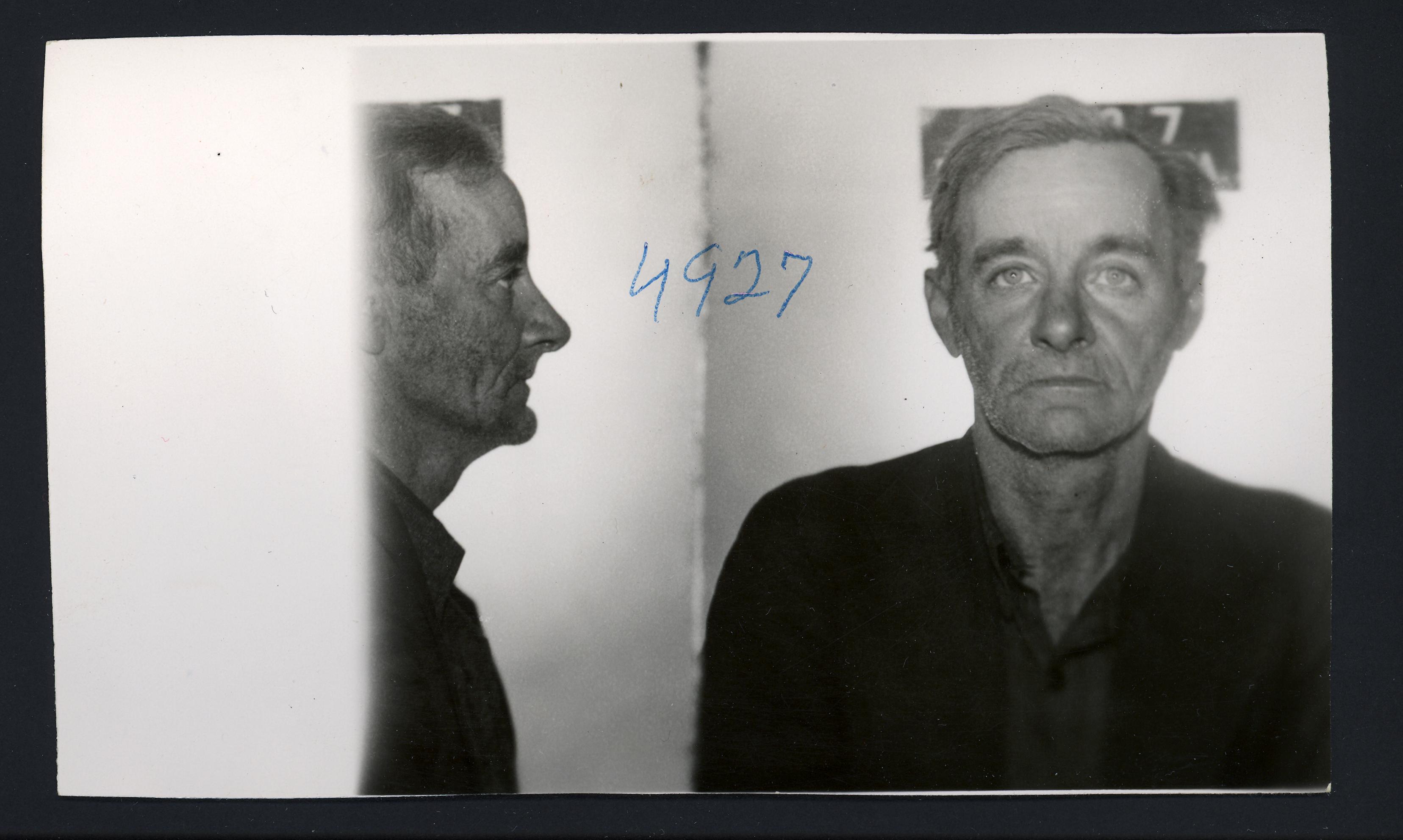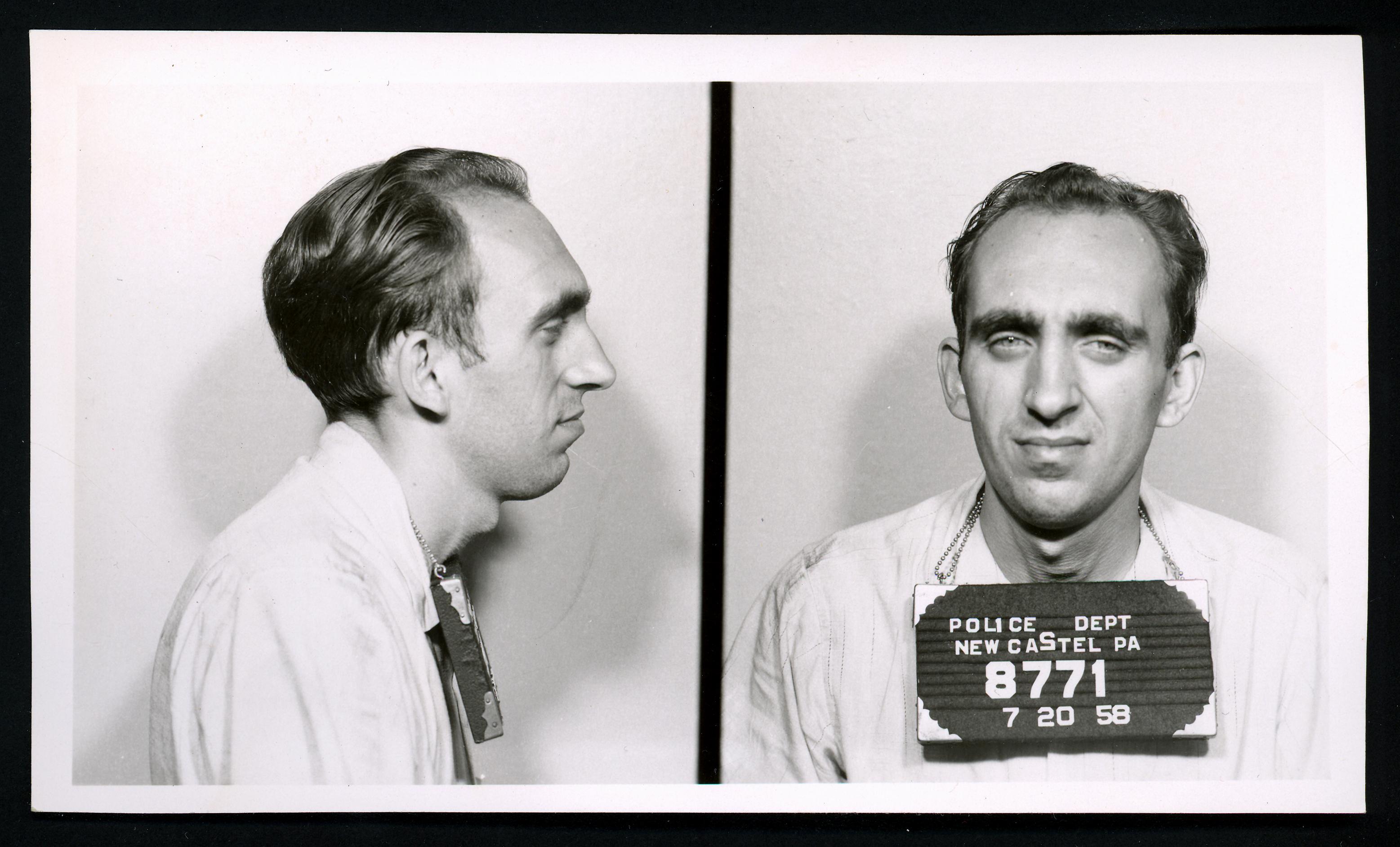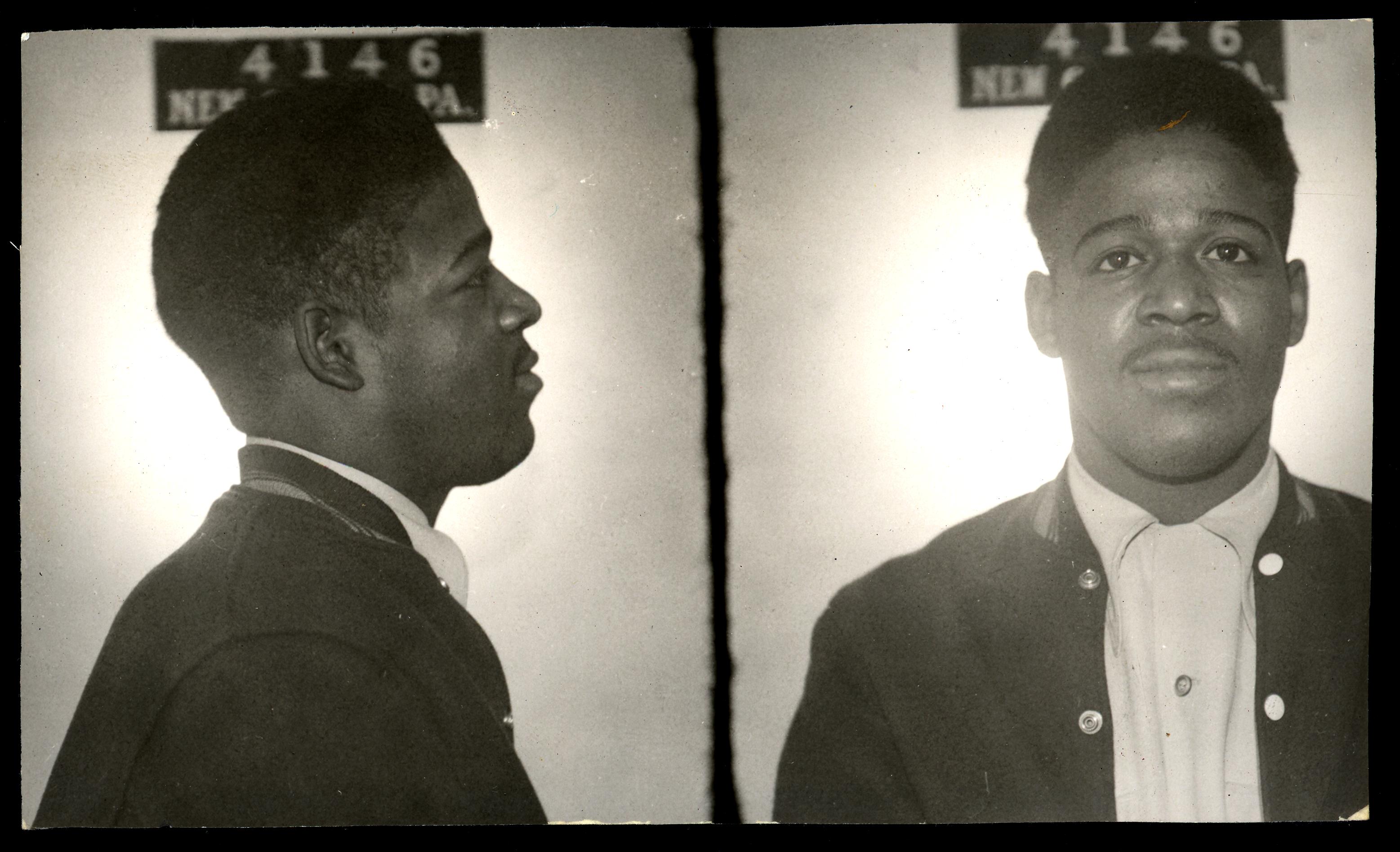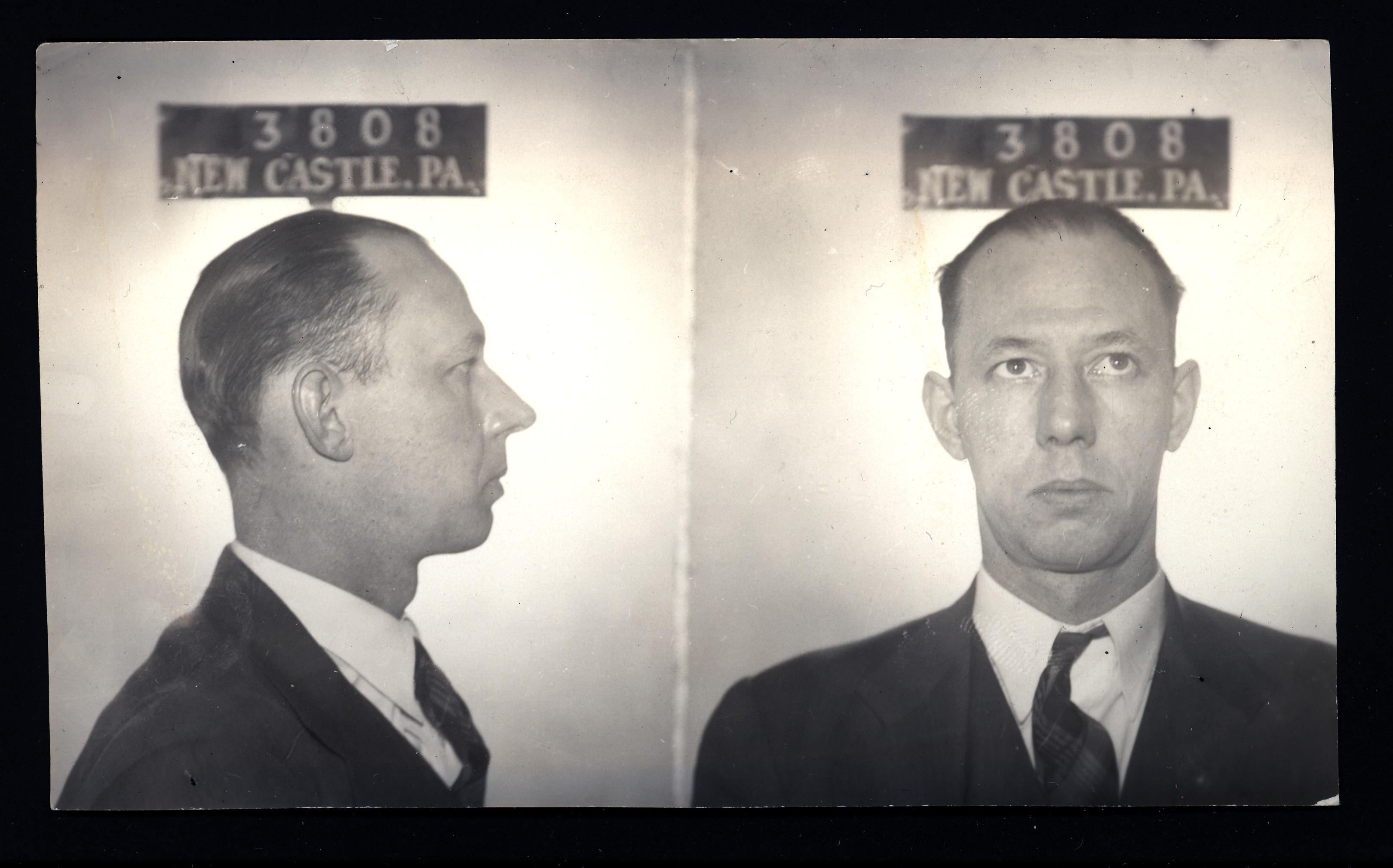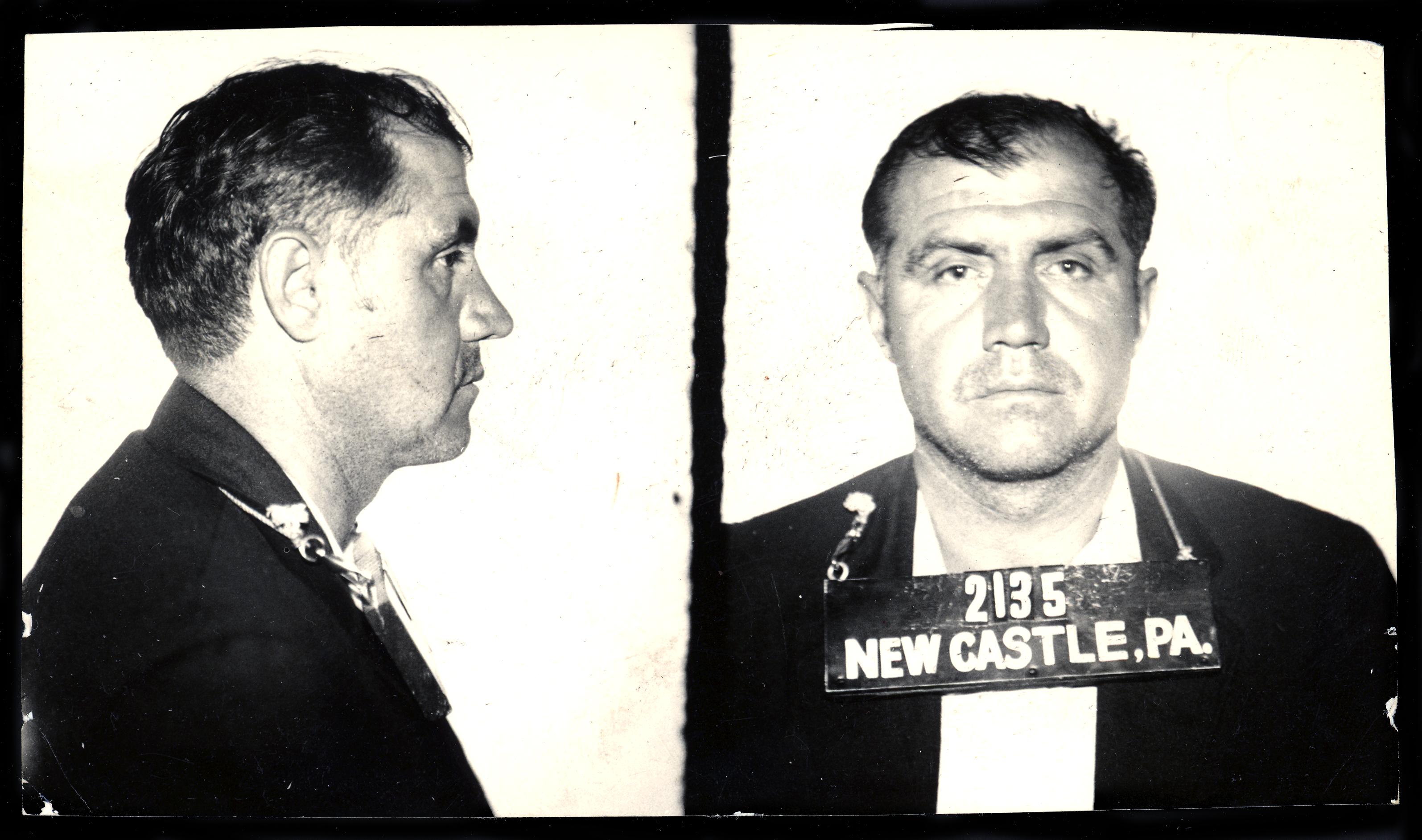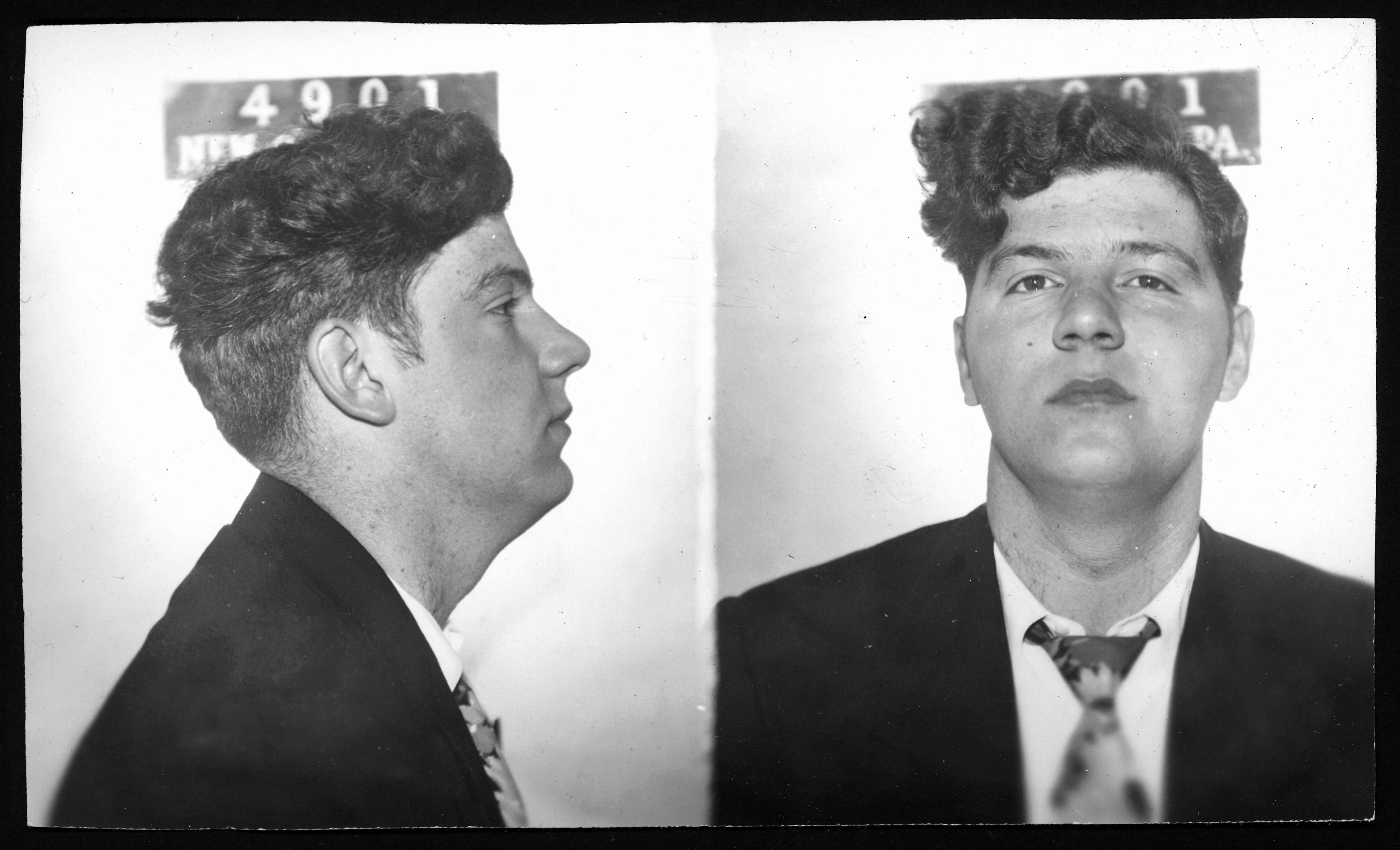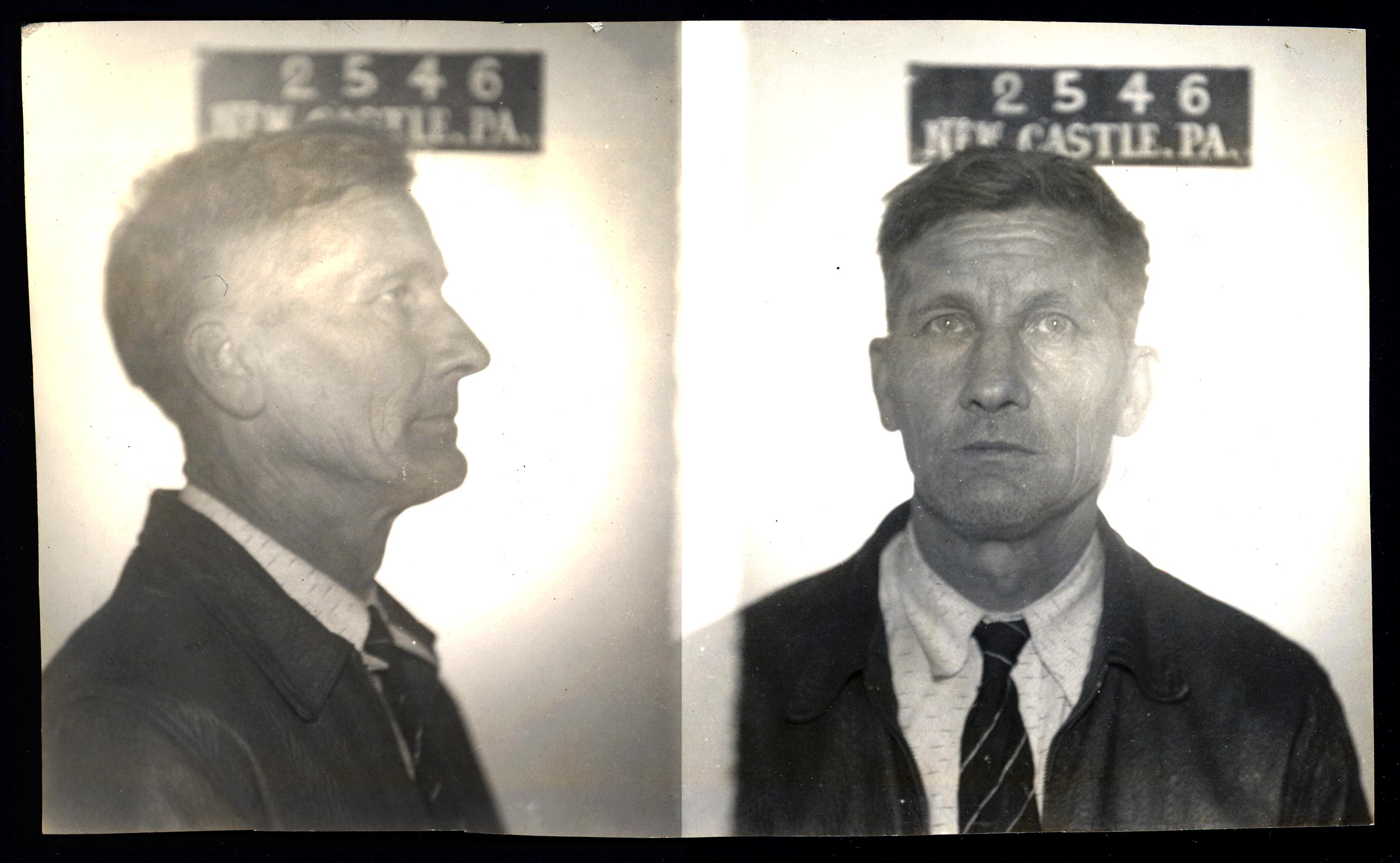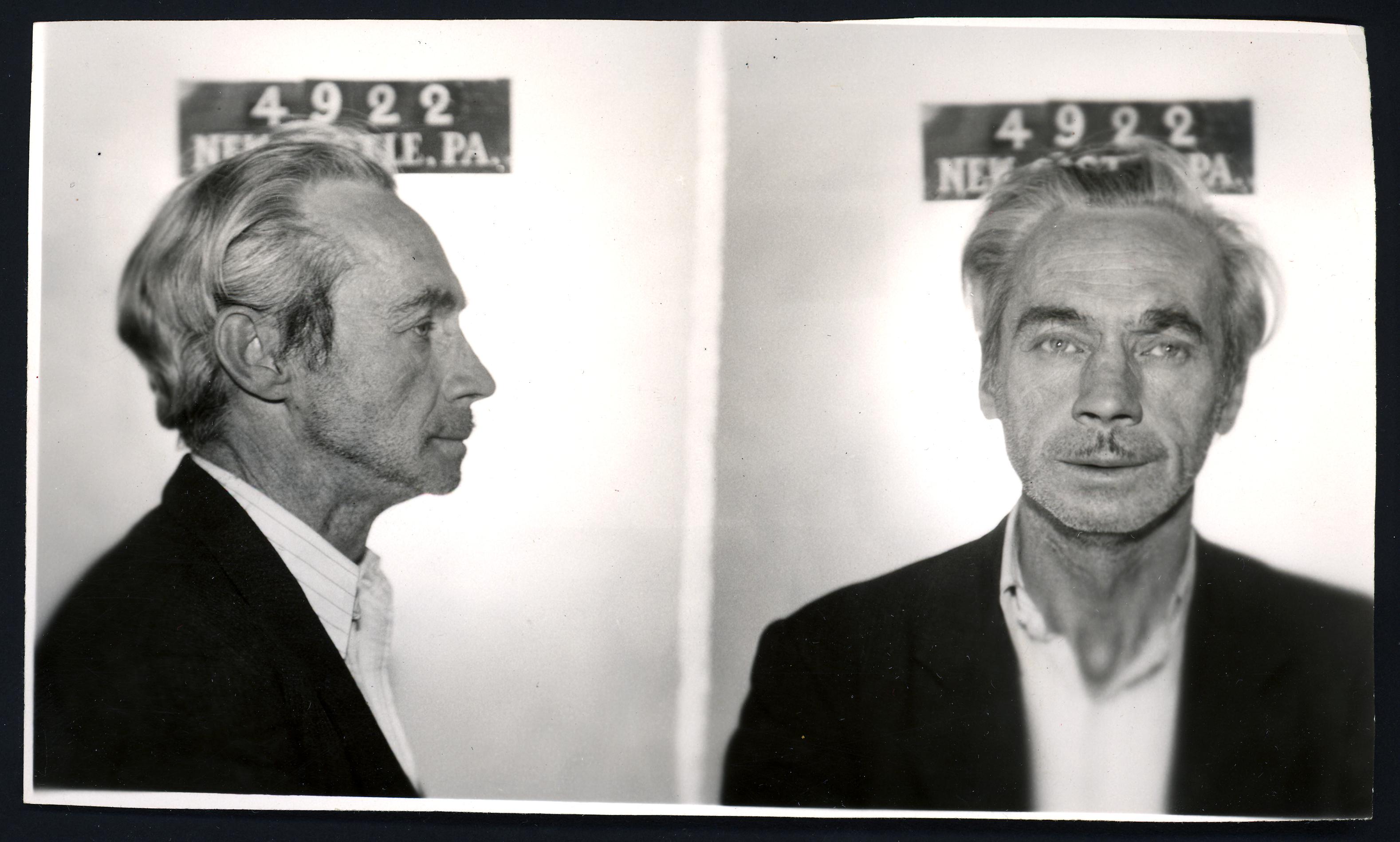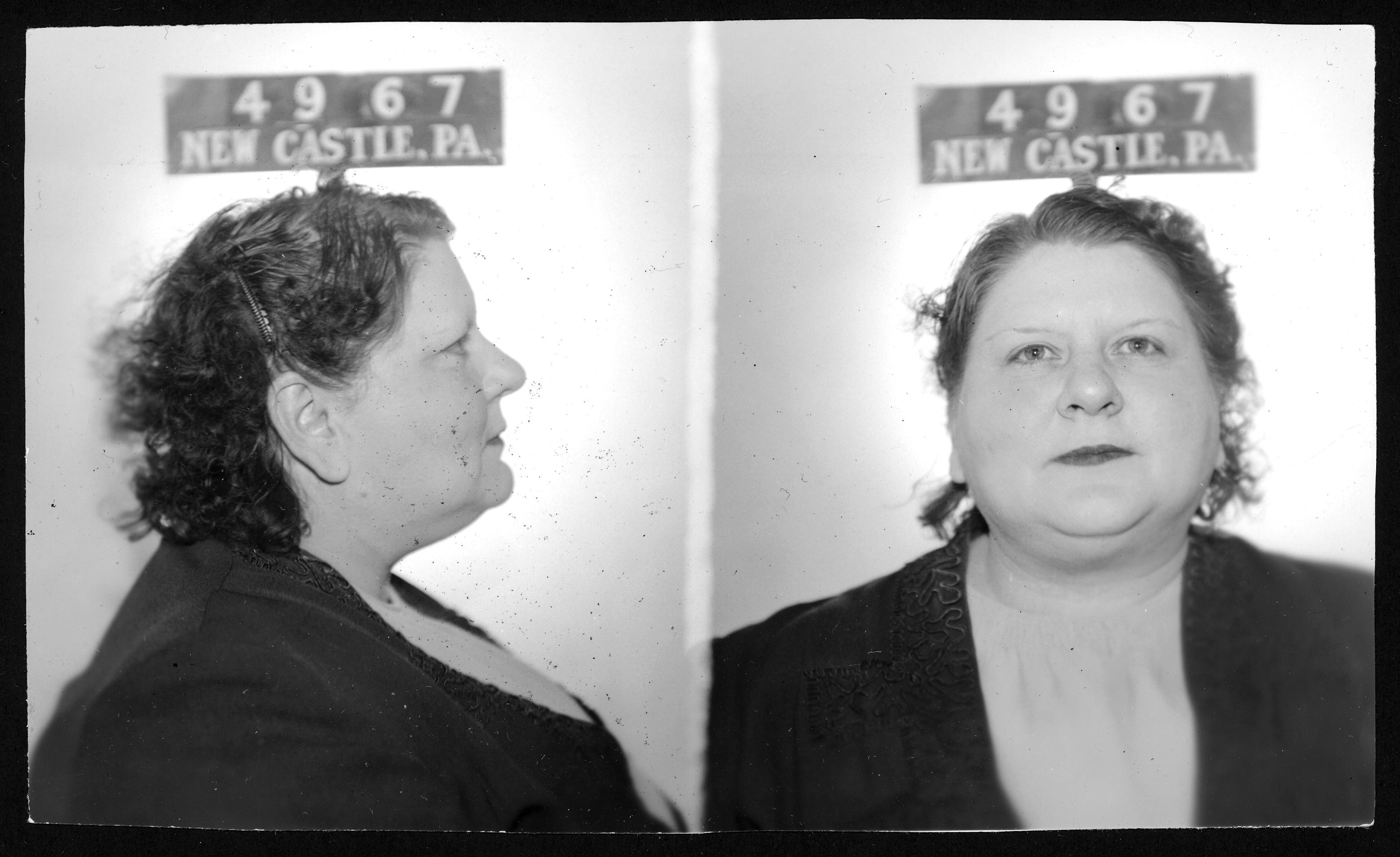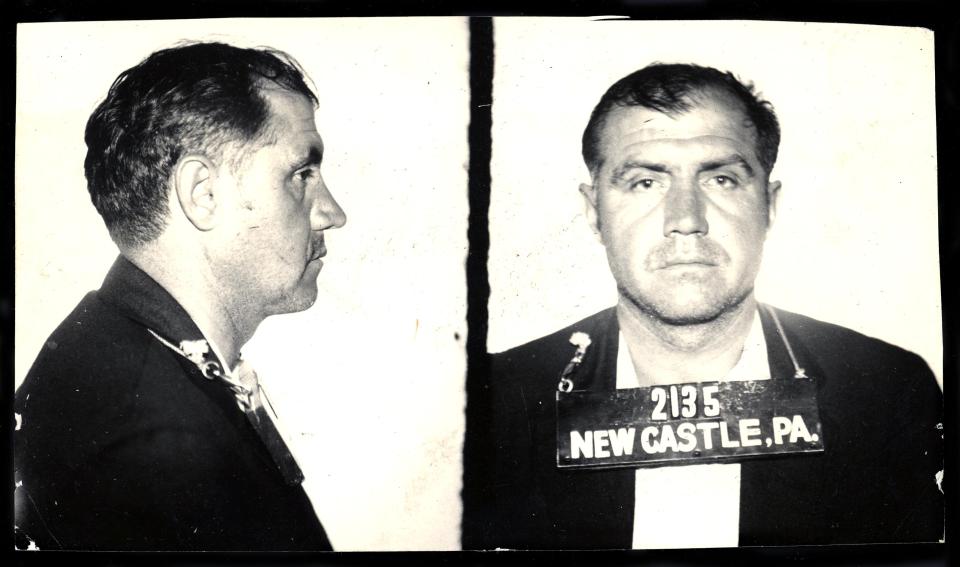
Earl Bryan, “Larceny”, 21 April 1948

comment 1
Uncategorized

The negative was almost ruined by light flooding into the camera because the body wasn’t shut properly, and Earl was seated too close to the lens, which meant that his head entirely obscured the board with his booking number on it. (No one noticed that until after the print had been developed, when they wrote the number on the photograph in blue ink.)

Whoever took this picture wasn’t used to taking mug shots – an inexperienced operator, unfamiliar with the layout of the room and the workings of the equipment, left alone to process a prisoner of little importance who had been charged with larceny, which is to say, shoplifting or stealing a bicycle or picking someone’s pocket.

The photograph was taken on 21 April, 1948, and none of the experienced officers would have wanted to waste time booking Earl. That day, every policeman in the city was out looking for the men who had broken into the Best Foods warehouse on Long Avenue around one o’clock that morning, removed the two hundred and twenty-five pound safe and transported it to a lonely road near Cascade park, where they forced it open and stole the $720 that it contained. The busted shell was found later by two small boys passing by on their way to school.

The thieves were never caught. The Best Foods company closed down years ago. The money is long since spent. The only remaining evidence of the robbery is this botched mug shot of Earl Bryan, who had nothing whatsoever to do with it.

Sources: New Castle News, 21 April 1948, “Safe Is Stolen; Yeggs Get $720”.

Anthony DeCaprio, “Murder”, 12 October, 1937

comments 13
Uncategorized

Every Friday, the Harvard sandwich bar in Cleveland cashed thousands of dollars-worth of payroll checks for workers from the Fisher Body plant. The only security was provided by an auxiliary policeman who had been hired to watch over the money.

On the sixteenth of April, 1937, Anthony DeCaprio drove Joseph Taylor and Theodore Slapik to the sandwich bar and sat outside with the engine running while they went in. Minutes later, he heard shots—the sound of what witnesses would later describe as a gun battle between the stick-up men and the auxiliary policeman, Lawrence Krull. Taylor and Slapik came out, carrying bags stuffed with cash. They got away with $1,700—a steelworker’s yearly wage—leaving Krull lying on the floor of the sandwich bar with three bullets in him. When they checked the papers the next day, they would have seen that Krull was in a critical condition in hospital. On Sunday, they would have read that he had died.

They agreed to split up and leave Ohio. Joseph Taylor went west to Illinois, where he got a job as a layout man with the Ringling Brothers circus, Theodore Slapik went north to Michigan and Anthony went east to New Castle, where he had family, and rented a room on South Walnut street.

Four months later, in August, Taylor was arrested in Chicago and Slapik was picked up in Detroit. In October, the New Castle police were informed that Anthony DeCaprio had been seen frequenting a dance hall on Neshannock avenue. Two detectives from Cleveland travelled to New Castle and identified Anthony as he danced with a girl. They arrested him at gunpoint as he left the dance floor. That night, he admitted driving the car in the robbery. He was taken back to Ohio the next morning.

All three of the robbers were found guilty of murder and received life sentences in the Ohio penitentiary. Anthony was nineteen years old.

Theodore Slapik was released in 1955, when the governor of Ohio decided he was eligible for parole (he had been working as the governor’s driver for some years) and, in 1957, Joseph Taylor escaped from his job in the prison’s sewage disposal plant but was caught two hours later. Anthony DeCaprio served fifteen years of his sentence. After his release, in 1953, he became a truck driver, got married and had five children. He died in July, 2000, at the age of eighty-two.

Sources: Lima News (17 April 1937, “Officer Shot In Gun Battle”, 2 August, 1937, “Man Seized In Ohio Killing”, 14 Oct 1937, “Held In Slaying”, 30 Nov 1937, “Former Lima Man On Murder Count”, April 12 1938, “Seven Sentenced”); Piqua Daily Call, 19 April, 1937, “Weekend Traffic Toll Over State”;  Circleville Herald, 2 August 1937, “Circus Man, 28, Named Slayer Of Detective”; Lima News, 23 Sept 1937, “Three Desperadoes Hunted After Fleeing Jail”; New Castle News, 13 Oct 1937, “Suspect In Cleveland. 0., Crime Taken”; Piqua Daily Call, 29 Oct 1937, “Life Sentence for Man Hangs Over Him Today”; Zanesville Signal, 1 Nov 1937, “Slapik Pleads Guilty To Murdering Of Officer”; Coshocton Tribune, 3 Nov 1937, “Killer Starts Term”; Times Recorder (Zanesville), 6 Jan 1938, “Trial Of Alleged Slayers”; Coshocton Tribune, 7 Feb 1938, “Three Face Life Term in Ohio Pen”; Times Recorder (Zanesville), 12 April 1938, “Life Sentence For Slayer”; Sunday Times Signal, 10 April 1955, “8 Ohio Slayers Get Easter Commutations From Lausche”; Coshocton Tribune, 20 March 1957, “Convict Nabbed Soon After Making Escape”.

Lamarr Warter, “OMVWI”, 20 July 1958

comments 2
Uncategorized

Driving home on Taylor Street after spending Saturday night in a bar, Lamarr Warter lost control of his car, crashed through a cement-block wall and collided with a fruit tree in Mike Russo’s front yard. Lamarr survived, but the fruit tree did not.

It was the second road accident on Taylor street that day. Shortly before six that evening, a car driven by a young man called Joseph McKee hit a nine-year-old boy called Matthew Circelli. The child was thrown ten feet down the road, fracturing his skull and breaking a leg. By the time Lamarr crashed into the Russo’s yard later that night, the boy’s skull had been operated on by surgeons in New Castle hospital and he was lying in a coma. He never woke up. Two days after the accident, he became the thirteenth person in Lawrence County that year to die after being hit by a car, and the third in New Castle.

Joseph McKee wasn’t charged in connection with Matthew Circelli’s death, as there was nothing he could have done to avoid the boy, who ran out into the street right in front of his car. Lamarr Warter had his licence suspended for a year, as Mike Russo’s fruit tree was entirely blameless.

Seven months later, Lamarr was arrested for driving under suspension and was given ten days in the county jail.

Sources: New Castle News (“Arrest Motorist On Three Counts” 21 Jul 1958; “Struck By Car, Injured Boy Still Critical” 21 Jul 1958; “Youth’s Death 13th In County” 23 Jul 1958; “Hearing Slated” 17 Feb 1959; “12 Sentenced In County Court” 26 Feb 1959)


Robert Watkins, “Highway Robbery”, 16 Aug 1944

comments 2
Uncategorized

Robert Watkins was six years old in April, 1934, when his sister Daisy was assaulted by a neighbor who she had to fight off with a butcher knife. He may have watched Daisy being beaten or seen her stabbing the man. He would certainly have seen the blood in the kitchen. If he had been old enough to read the short, lighthearted report that appeared in the paper the next day, he might have wondered why it had treated the attack like a joke. If he had read the paper every day, he’d have soon realised that that was how it reported most incidents of violence involving colored people.

Robert was the youngest of seven children, many of whom were in trouble with the law throughout their lives. Daisy went on to run a moonshine joint in her house in the fifties; Charles and Richard were repeatedly arrested for stealing coal throughout the thirties; Charles robbed a café in 1939; Richard was arrested for window peeping in 1945 and beat Jessie Ashe to death in 1951 in an argument over $2; and Maria, the oldest sister, shot Eloise McClinton dead in a drunken argument in 1970.

Robert was arrested when he was sixteen. One August night in 1944, at about half past two in the morning, he and three other boys followed a Polish tin mill worker called Joe Kolakowski onto the Mahoning avenue viaduct, where they beat him up and robbed him of $18. When the description of the group was broadcast later that night, a young patrolman called James Brown—“also colored”, noted the paper—remembered seeing “a suspicious quartet” in Moravia street just after the incident, and he and another officer picked them up within the hour. All four pled guilty the next day.

That was the start and end of Robert’s criminal career. Years later, when New Castle’s economy began its long, terminal dive after the Korean war, when the factories shut down and jobs got scarce, Robert headed to Sacramento, California, leaving his family behind him. He never went home again.

Sources: New Castle News (3 May 1934 “He Wields Poker; She Uses Knife”; 3 July 1936 “Coal Thefts Lead To 30-Day Jail Trip’; 1 July 1937 “One In Hospital; One In City Jail; Following Quarrel”; 9 Dec 1938 “Nab Trio Today For Stealing PRR Coal”; 23 May 1939 “Two Arrested In Long Ave Café In Early Morn”; 19 Feb 1940 “Marriage License Applications”; 15 Feb 1943 “Plan Prosecution For False Alarm”; 16 Aug 1944 “Quiz Robbery Suspects Here”; 17 Aug 1944 “Four Plead Guilty To Viaduct Robbery”; 8 March 1950 “Deaths of the Day”; 15 May 1951 “Murder Charge Will Be Placed”; 22 December 1970 “Marie Hill innocent”; 12 Jul 1975 Deaths Of The Day)

Charles J Krueger, “Assault, Battery”, 4 Feb 1942

comment 1
Uncategorized

Two months after Pearl harbor, New Castle’s chief of police, Willis McMullen, issued a statement to inform the citizens of the town that “War is here” and that, consequently, they should refrain from bothering the police with trivial complaints.

“Enemy aliens admittedly are scattered across the United States. It may be that some of them would be saboteurs and may attempt to cripple industry or public utilities,” he declared. If police had to take time out from their multitudinous duties to deal with unimportant matters, he explained, they might be unable to go into action swiftly should any untoward enemy activity take place in the town, which might result in loss of life or the destruction of property that might be vital to the war effort.

Chief McMullen pointed out that such calls as “dogs running loose”, “whether or not the streets are ashed” and “the time of day or night” were not important police functions during war time.

“Let us co-operate for the benefit of all concerned,” he continued. “Our boys are fighting in all sections of the world. We, back home, must keep essentials going to them.”

McMullen’s statement concluded by reminding the town that the enemy could strike anywhere, at any time. “Pearl Harbor was an instance. We were attacked without warning. An enemy doesn’t ‘brass band’ his effort. Let us settle down and eliminate unimportant things.”

However, that night, 4 February, 1942—as US fighter planes engaged Japanese bombers in combat over Java, as British troops fought a losing battle to keep the Japanese out of Singapore, and as columns of Axis vehicles rolled through Libya—Charles J Krueger disappointed Chief McMullen when he forced the police to divert their attention from their vital war-time duties in order to arrest him on a charge of assault and battery.

Luckily, enemy aliens did not choose that night to launch an attack on New Castle. The town’s industrial plants remained fully operational for the rest of the war.

Sources: New Castle News, 4 February, 1942, “Don’t ‘Phone Trivial Complaints To City Police Headquarters”

Thomas Herovich, “Robbery Armed”, 30 June 1936

Leave a comment
Uncategorized

Prohibition was repealed on 5 December, 1933, but not one legal drop of liquor was served in New Castle that night. Any private celebrations involved bathtub gin, bootlegged whisky from Canada or the moonshine that was locally referred to as Moravia street bourbon, as nowhere in town was licensed to sell alcohol.

That week, the state bought the old C Ed Smith Furnace Company workshop on Produce street, on the east side, and commissioned workmen to convert it into New Castle’s first state liquor store. A month later, when the store opened, the building had been transformed into an edifice with “the neat appearance of a well kept penitentiary.” The windows were protected with steel bars, five-eighths of an inch thick; the glass was wired to set off an alarm if broken; and entry to the establishment could be prevented by the formidable, reinforced door. Plain gold letters across the front of the building read simply, “Liquor Store Pennsylvania Liquor Control Board”.

The state had decided to tolerate the sale of liquor, not encourage it, and the liquor store was not supposed to be a pleasant place to visit. Nevertheless, in the two hours for which it was open on its first night of business – Saturday, 6 January, 1934 – it sold more than $1,000-worth of liquor to around 250 customers, serving one customer every thirty seconds. Soon, sales settled down to a healthy rate of around $1,100 a day – all in cash, as it was illegal to buy liquor on any sort of credit.

The store was robbed for the first time less than two years after it opened.

Thomas Herovich had been sent to jail for eight years in the twenties for an armed robbery in Springfield, Ohio. He was released in the middle of the depression, not long after the Wall Street crash – a middle-aged ex-convict with no trade. Naturally, he returned to his previous profession and was soon wanted by the police in connection with the robberies of a bank in Columbiana, a theater in Sharon and a club in Farrell.

On October 19, 1935, Thomas entered the liquor store with two young associates, Eugene “Slim” Doyle and Frank Bydo. He grabbed a customer and shoved a pistol against his stomach, saying he’d shoot if the clerks didn’t hand over all the money. Doyle and Bydo collected the cash and ran out to the stolen car they’d parked outside. Thomas followed once they got the engine running, leaving his hostage on the street.

The gang got away with $375. They would have discovered when they read the papers the next day that the clerks had held back $700, but there was nothing that they could do about it by that point.

A few months later, Thomas was arrested in Struthers, Ohio, on suspicion of being a finger man in a robbery there. The Pennsylvania state police asked that he be loaned out to them so witnesses in New Castle could have a look at him, and the liquor store hostage identified him as the man who’d held him at gunpoint. Thomas made a full confession that night. He was sentenced to six to twelve years in the Western penitentiary. Slim Doyle and Frank Bydo, who were picked up within the month, each got two to four.

The liquor store was robbed several more times over the years, the biggest haul being taken in 1947, when two masked bandits armed with pistols escaped with $1,263.

By the end of the thirties, three more state liquor stores had opened in New Castle, all in far better locations. The Produce street store eventually became the area’s liquor warehouse and was closed down in 1973, with all operations being transferred to Pittsburgh. All the buildings on the street were demolished not long after, and the area is now a parking lot.

Sources: New Castle News (23 Dec 1933 “State Liquor Store Being Made Ready”; 8 Jan 1934 “State Liquor Store Is Open”; 20 April 1936 “New State Store Will be Opened”; 1 July 1936 “Suspect Admits He’s Liquor Store Robber”; 13 July 1936 “Liquor Store Bandit Surrenders”; 20 July 1936 “Third Suspect In Liquor Store Robbery Taken”; 29 July 1936 “Liquor Store Bandits Given Prison Terms”; 1947 April 14 “State Liquor Store Held Up”; 22 Jan 1973 “State Liquor Warehouse Will Close”)
 

Joe Relo, “Intox Driver”, 13 March 1948

Leave a comment
Uncategorized

Joe Relo joined the navy after he graduated from high school in Struthers, Ohio, at the end of world war 2. One Saturday night in 1948, when he was home on furlough from the Pacific, he drove his old school friends, Joe Mediate and Bill Marr, twenty miles to New Castle, just over the state border. They passed the night in the bars downtown and it was nearly one in the morning before they got back to the car, each extremely drunk, and set off for Ohio.

As soon as Joe pulled out into the street, he found himself stuck behind a cautious motorist who stopped at the red light at Moravia Street and Long Avenue even though the streets were deserted. Joe could see no reason why they should stop. Thinking of the long drive home, Joe leaned hard on his horn, again and again, cursing the driver in front, but the car did not move. Bill and the other Joe tumbled out of the car to talk to the driver—just to explain to him how far they had to go that night and to say that he should show a little consideration and either go through the red light or pull over so they could go through the red light—but he took it the wrong way and thought they were trying to start trouble.

Things got a little out of hand. Before long, the police arrived and arrested everyone.

The boys spent the rest of the weekend in the cells. Bill Marr and Joe Mediate were fined $10 and $5 respectively (Bill got the larger fine because the cops thought he had been resisting arrest even though, as he told the police court, he’d only been trying to explain to them the situation as he saw it), and Joe Relo received the standard New Castle penalty for drunk driving: thirty days in the county jail and a fine of $100 and costs, out in three days if the fine and costs were paid.

Joe left the navy in 1950 and joined the Struthers fire department, where he remained until he retired, in 1984, at the age of fifty-seven.

Sources: New Castle News (15 march 1948 “Arrest Driver And Companions”; 20 March 1948 “Judge Lamoree Sentences Seven”); Youngstown Vindicator, 15 Jan 1984, “Relo To Retire As Firefighter”.

Frank Tomski, “S & P of M.BVS” 8 September 1937

comments 4
Uncategorized

Frank Tomski was charged with the sale and possession of hard liquor while having only a malt beverages license. Prohibition had been over for four years, but the black market never went away. He paid a fine of $300 to avoid three months in jail, but he was arrested on the same charge later in the year and sent to the Alleghenny workhouse for six months. The morning he was taken away, his son, Chester, was sent to Huntingdon reformatory for stealing cars. Frank’s wife was left to run the farm and look after the other eight children.

Two years later, Frank fell ill and was dead within the day. He was fifty-eight.

Sources: New Castle News (3 April 1937, “Sentences Are Passed”; 16 October 1937, “Mains Sentenced To Penitentiary For Three Years”).

Paul Bailey, “Dis Conduct”, 18 April 1948

Leave a comment
Uncategorized

Paul Bailey was arrested midway through the first sunny weekend of the spring of 1948, which followed weeks of heavy rain. All over Lawrence County, people went fishing, played baseball or golf or just took the opportunity to sit on their porches. For his part, Paul celebrated the good weather by getting drunk enough to be charged with disorderly conduct.

Meanwhile, the town’s criminal element embarked on a minor spree, with four burglaries being reported over the weekend: thieves broke into the Giancotti service station on Croton Avenue in order to loot the cigarette machine, making off with $35 in coins and 125 packs of cigarettes; someone stole an electric iron, a radio and some food from the McCue house on West North Street; C R Allen, of West Front Street, reported that a radio, an electric razor and a cap pistol had been taken from his house; and Mrs Missey, who lived in an apartment in the Fisher block on Long Avenue, reported the theft of shirts, sheets, a dress and some towels. There appears to have been no suggestion that the crimes were connected.

Sources: New Castle News 19 April 1948, “Pa Newc Observes”, “Robbery And Theft Reports Made To The Police”.


Elizabeth Miller, “Liquor Violation”, 5 June 1948

Leave a comment
Uncategorized

In January 1948, a young woman called Anna Grace Robertson suffered fatal brain injuries when she fell from a moving truck – or was pushed out; no one knew for sure. What was certain was that she had been drunk when her skull cracked on the road, and that the man who she had been with, Martin Fobes, had been drunker still, as had most of the witnesses who testified that they’d seen Fobes and Anna Grace drinking until well after midnight in the Rex Café, Jim’s Place and the Square Deal Café.

There wasn’t enough evidence for a trial, and Fobes was released, but the inquest had focused New Castle’s attention on the lawless liquor joints in the industrial district, frequented by hard-drinking factory workers speaking a babble of old-world languages and run by management that wasn’t too particular about local liquor laws.

Something had to be done.

In the months following Anna Grace Robertson’s death, agents from the state liquor board quietly investigated the town’s bars and cafés, collecting evidence, filing reports and compiling lists of transgressions. Then, on a busy Saturday night, the police raided establishments across the centre of town – the West Side Café, the Lawrence Confectionery, the Grant Street Café, the Marathon and others – rounding up not only the drunks, but the bartenders and bar owners, who ended up in court facing heavy fines.

Elizabeth Miller worked in the Rex Café, “The Home of the Big Mug”, which had featured prominently in the inquest into Anna Grace’s death, as it was where she’d met Fobes and where Fobes had returned to get “pretty well loaded” the night after her battered body was found in the street. Elizabeth and the owner, Demetrios Proios, were arrested and charged with various breaches of the liquor laws, including serving liquor to intoxicated persons, and were fined $100 and $150, respectively.

However, perhaps because of its notoriety, the authorities seem to have gone after the Rex harder than the other places. The district attorney declared it to be a common nuisance, a haunt of undesirables and the source of much of the trouble in the area. He pointed out that, despite the fact that it was licensed only to sell liquor to accompany meals, it had done $33,808 worth of beverage business in the preceding year and only $699.80 worth of food business. State liquor board agents said they’d observed minors and men with criminal records being served alcohol and stated that the place was insanitary, that disorder was marked and that they’d seen no food ordered or served; and the city chemist testified that the whiskey glasses that he had examined were thick with “more bacteria than I could count.”

In August, the city padlocked the doors of the Rex Café, pending an appeal, which was lost. In September, the café was closed for good. Elizabeth Miller was out of a job.

Before the Rex Café opened, the building had housed Ginsberg’s kosher delicatessen on the ground floor with Faella’s barber shop – “25¢ any style any haircut” – and a Catholic boy’s club upstairs. Earlier still, in the twenties, it had been Bevan & Arthur’s magazine store and restaurant; and, at the beginning of the century, when it was still new, it was New Castle’s only kosher hotel, run by one Nathan Rabinovitz, whose annual application for a liquor licence was always refused.

The block was demolished in 1968. A Burger King sits on the site today.

Sources: New Castle News (14 Jan 1948 “Cause Of Girl’s Death Is Mystery”, and other pieces that month on Fobes; 7 June 1948, “Fifteen Facing Liquor Charges”; 3 Aug 1938 “Seeks To Revoke Café License”; 12 Aug 1948 “Café Is Nuisance, Court Declares”; 11 Sep 1948 “Court News”; 1906 piece on Nathan Rabinovitz; 1915 piece on Bevan & Arthur; 1930 piece on Ginsberg.)