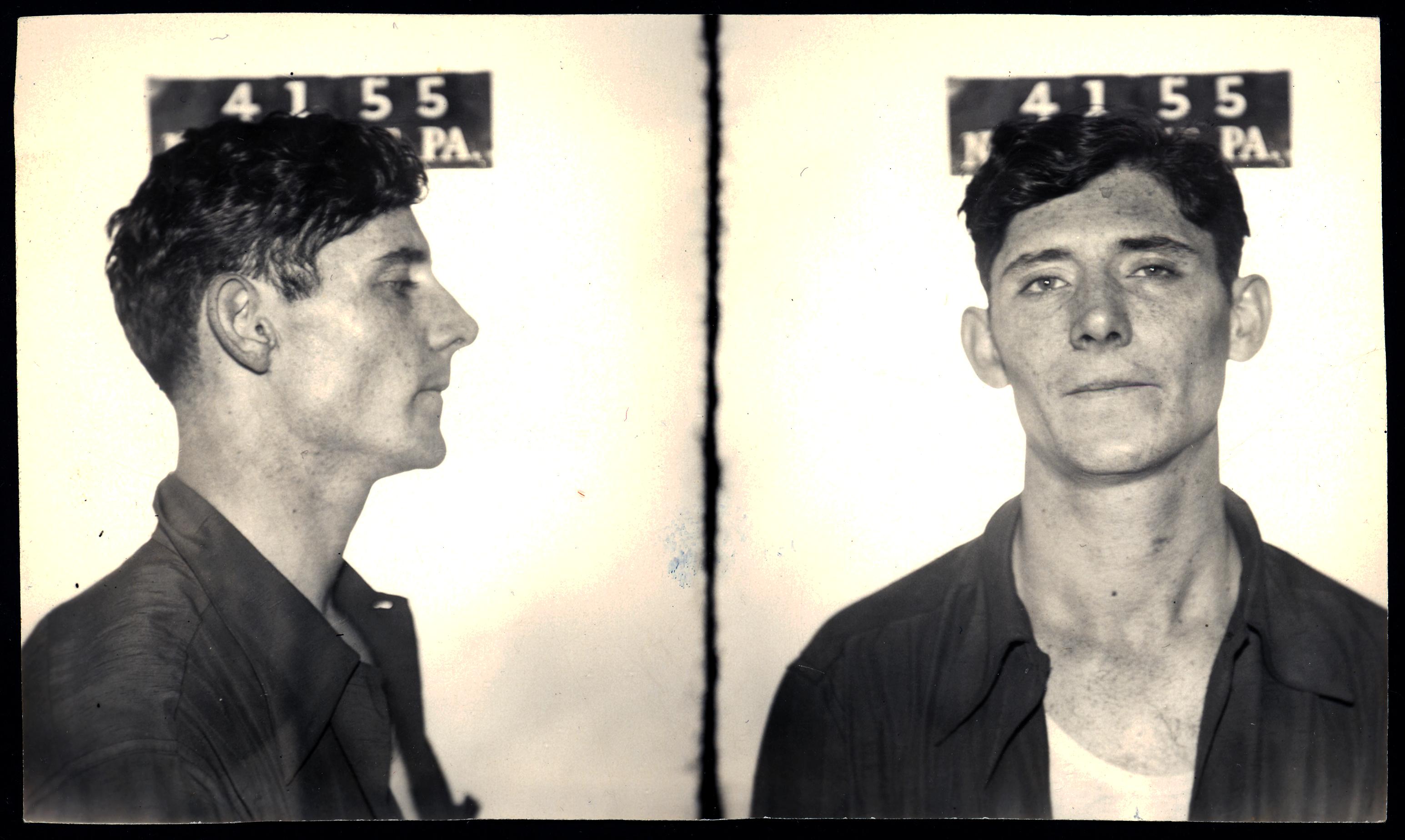
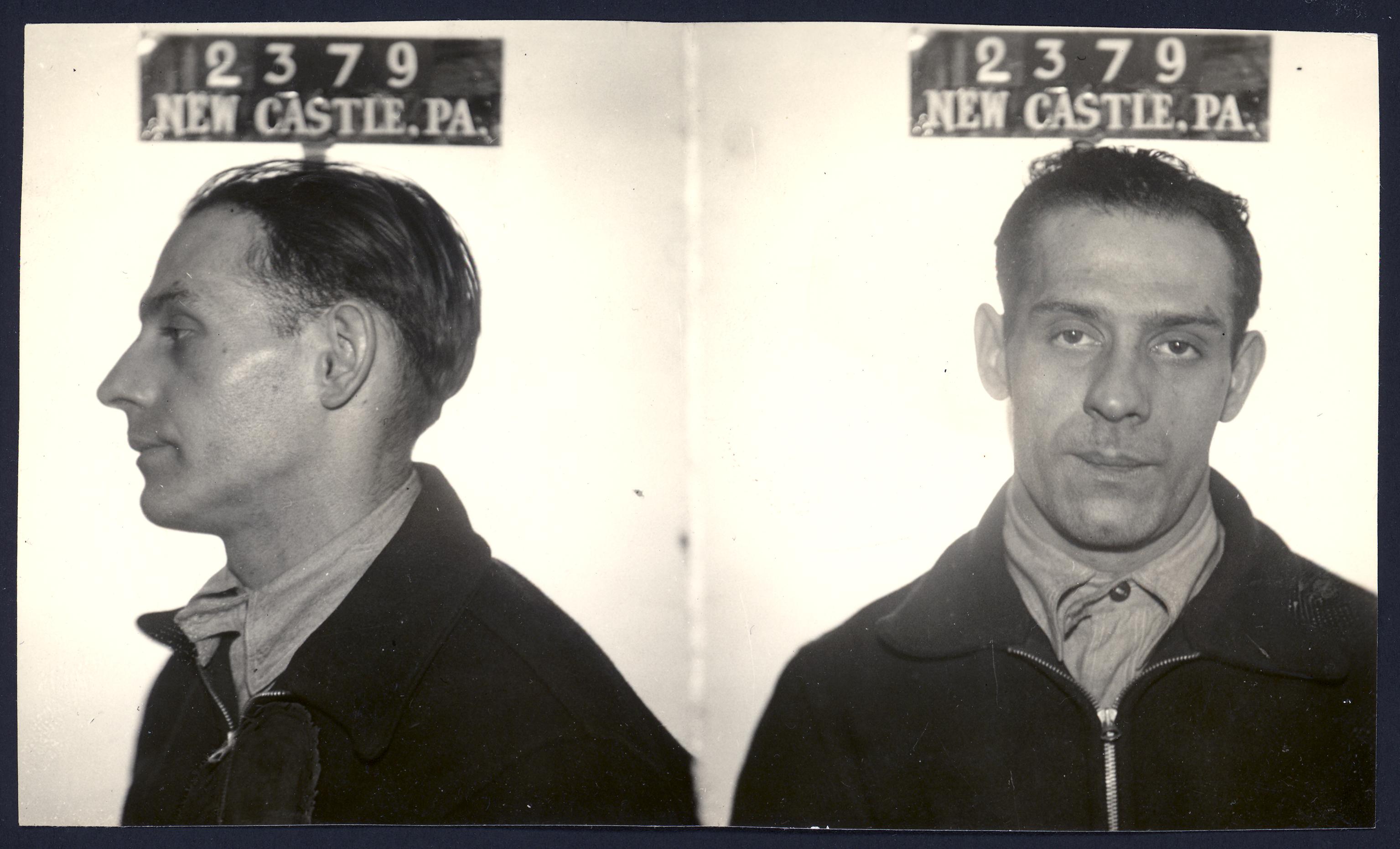
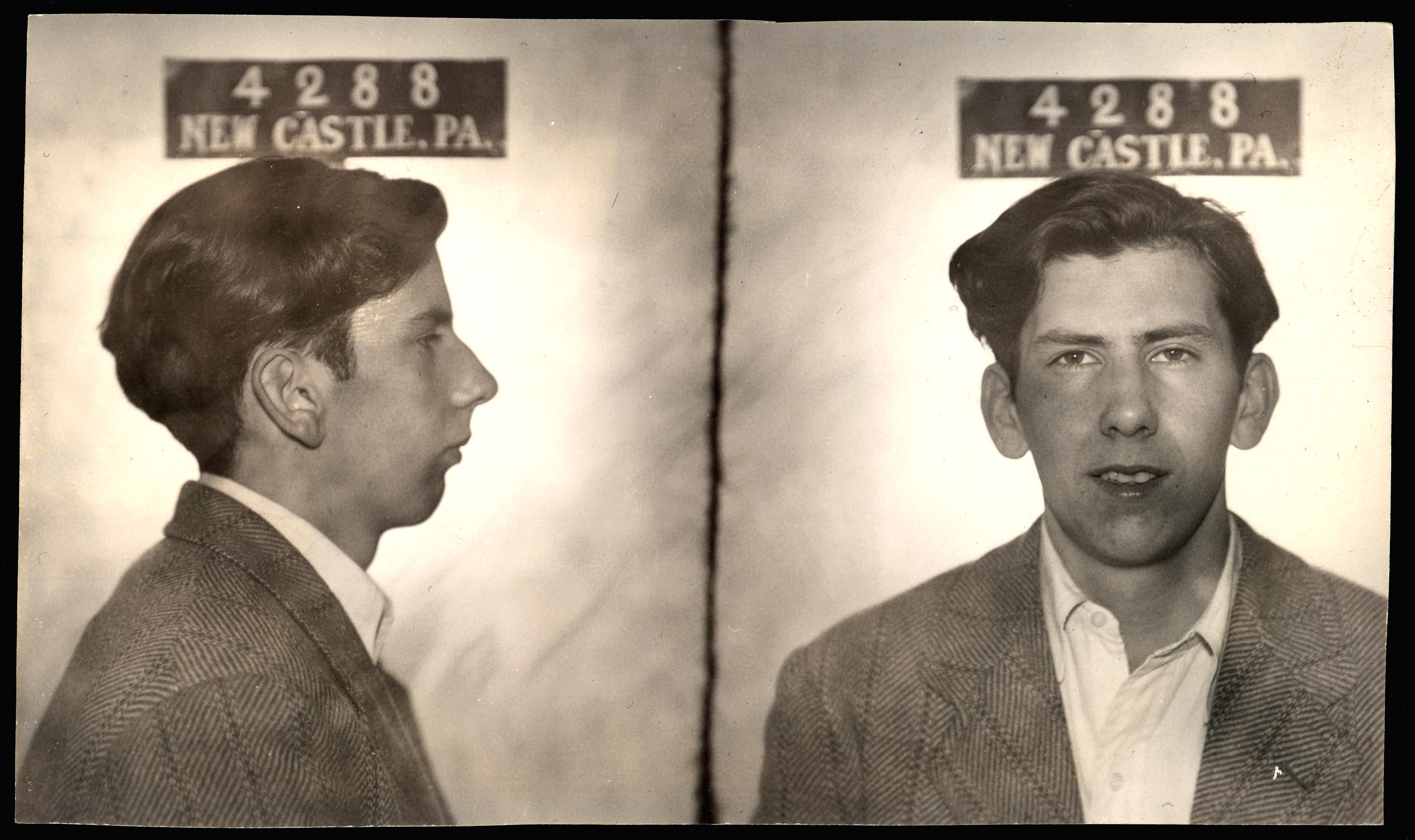
Frank Nye, “Hold Up”, 12 Sep 1929

comments 6
Uncategorized

In 1789, a revolutionary war veteran named Andrew Nye, the son of a German immigrant who had left Europe forty years before, bought four hundred acres of land on the banks of the Connoquenessing creek and set up a farm, where he lived with his wife, a dozen or so children, a horse, three or four cows and a yoke of oxen. Later generations of his family spoke of him as the first white settler within the bounds of the present Lawrence County, which might well be true.

New Castle was founded a decade later, some miles to the north of Andrew’s farm. By 1851, it had gathered a population of a few thousand people, including Andrew’s grandson, Thomas, who lived in a log cabin on New Castle’s main square. The Nye family continued to clear the land around the Connoquenessing, creating fertile farms that, towards the end of the century, were sold off piece by piece to private developers and industrial concerns who were involved in the creation of the new conurbation of Ellwood City. Some parts of the family grew rich; others did not.

Nathaniel Nye—the great-great-grandson of Andrew Nye—died in 1914, leaving his three children orphans. They were placed in the care of an old farming friend of the family, who was named executor of Nathaniel Nye’s estate and proceeded to sell the remainder of the land that he had owned. What became of the money is unknown but by 1929 at least one of Nathaniel Nye’s children, Frank, then twenty-six years old, was a homeless drifter.

As a teenager, he had spent more than two years in the Morganza reformatory for his delinquent and vicious behaviour. He went to work in a tin factory in New Castle, then joined the navy, spending two terms in the Portsmouth navy yard. After his discharge, he returned to the city, took a room in a hotel and started to look around for something to do.

On a Monday morning in December 1929, Frank was loitering in New Castle’s main square—within a few hundred yards of the site of Thomas Nye’s log cabin, long vanished—when he met a man called Edward Harris. By the end of their conversation, Frank had revealed that he owned a pistol, Edward had replied that he possessed a blackjack, bought for $1 from a Negro in Pittsburgh, and the two men had agreed to work together.

They spent a couple of hours going from store to store, trying to find a suitable prospect before settling on a South Jefferson street clothing store that was run by Louis Ruzewich, a man in his sixties.

The next day, just before six o’clock in the evening, Frank and Edward entered the store and Edward immediately struck Ruzewich on the head with his blackjack. The blow failed to down Ruzewich, who broke free as Harris grabbed for him and ran out into the street, locking the door behind him.

His shouts attracted a crowd of people, who gathered around the store’s front and rear entrances. When Frank worked out how to unlock the door and tried to leave, Charles Chirazzi, who owned the barbershop across the street, pretended to reach for a gun in his rear pocket and told the men to stay in the store. Frank backed off and hid his revolver under a pile of clothes while he waited for the police to arrive.

Officer McMullen was the first on the scene. Frank gave himself up and allowed himself to be handcuffed. Edward was discovered hiding under a counter in the storeroom and also gave up without a struggle.

Frank and Edward were charged with carrying concealed weapons, entering a building with intent to commit a felony and felonious assault and battery. They were sentenced to two to four years in the Western penitentiary at Rockiew, where Frank was given a job as a mail clerk. Six months later, Frank was ordered to deliver a package from the mail office to the main office outside the stockade. On his way out, he stole a suit of civilian clothes and a hat from a changing room and kept walking. He was never heard of again.

Sources: New Castle News (24 Nov 1922, “Local Boy Is Sent To Morganza School”; 13 Sep 1929, “Foil Store Hold-Up”; 14 Dec 1929, “Steve Garlich Indicted For Markota Murder”; 7 Dec 1929, “Pleas Are Entered; Sentences Passed”; 30 June 1930, “Man Sentenced Makes Escape”); Altoona Mirror, 3 July 1930, “Local Man Walks Off From Rockview Prison”; Nye family website main-family.com/nye/index.htm.
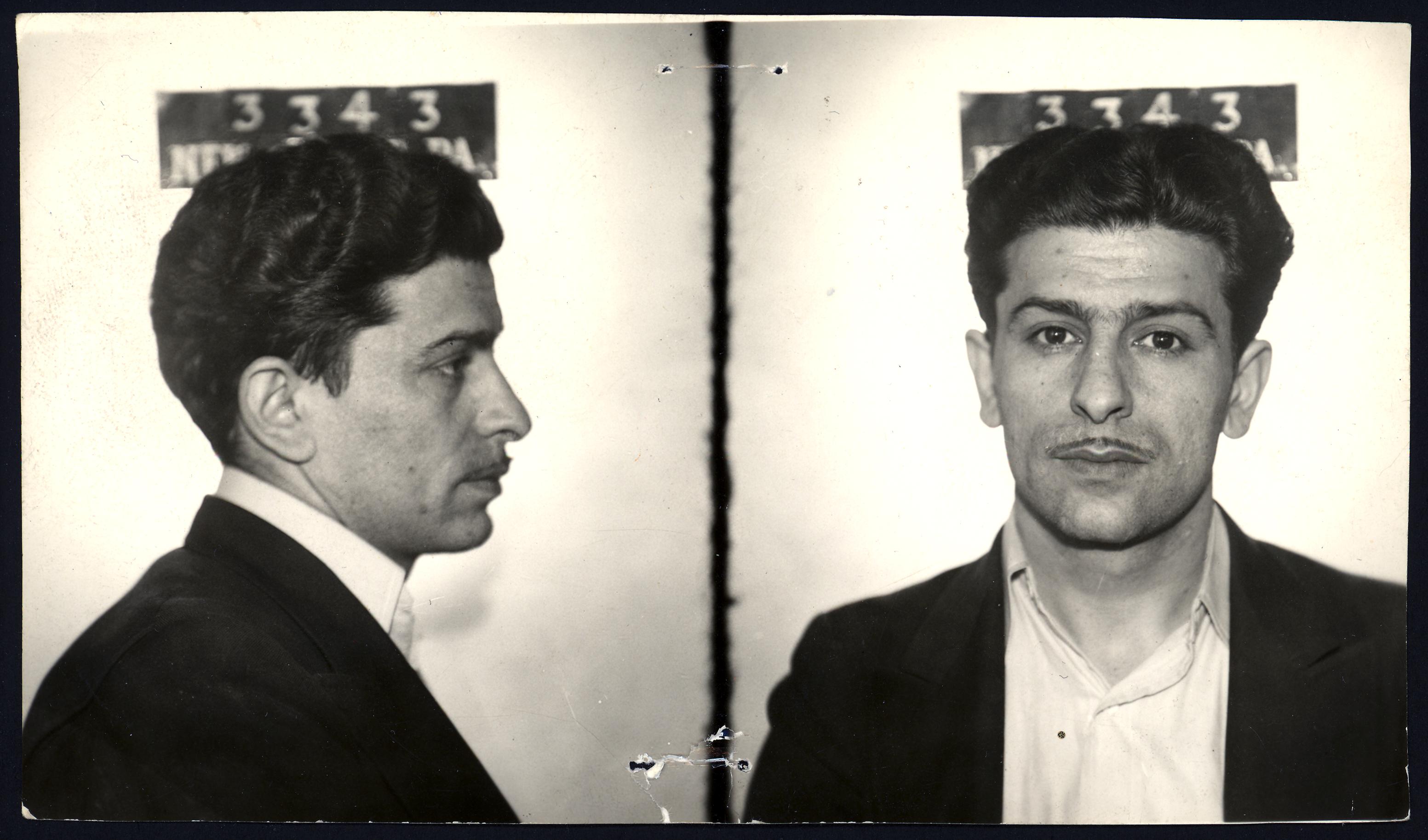
Ralph Largo, “Tampering with court witness”, 17 May 1940

comments 4
Uncategorized

Ralph Largo’s younger brother, Frank, had spent time in Huntingdon reformatory for larceny and had been arrested in the company of Vincent DeLillo, an incorrigible drug addict and thief, a few years before. He was on trial for living off a prostitute’s earnings—taking bawd money—and adultery. The prosecution’s case relied on the evidence of a young woman named Josephine Coloa, who was perhaps the prostitute in question.

Ralph arranged to meet Josephine for a drink at the Streamline café, then took her to the Rendezvous café, on the corner of Long and Moravia avenues—”Live Lobsters, As You Like Them! Chop Suey! All Food Prepared By Real Italian Chef, Big Sam Filippo!”—where he forced her to sign a statement that would clear his brother. He told her to stay off the streets and warned her he would kill her if she showed her face.

Josephine’s signed statement was read out in court, and Frank Largo was cleared of the first charge, although the jury found him guilty of adultery. (Frank’s wife divorced him the following year—1941—and a few months later he joined a government construction crew that was working to rebuild Pearl harbor. In 1946, he took part in a string of safe-cracking jobs and was sent to the Allegheny County workhouse for two years.) Ralph was arrested and charged with hindering and interfering with a witness. His trial took place before the first all woman jury in the history of the court house, which found him guilty. The judge sentenced him to time served (two months) and costs. On his failure to pay the costs, he was given a further six months in the county jail.

Ralph worked in the United Engineering and Foundry Co plant but was fired in 1942. He claimed he had been victimised for his union activities; his supervisor said he had been discharged for being an inefficient worker.

There is no further record of his life, apart from a handwritten note on the reverse of his mug shot, which reads, “Deceased Jan 1968”.

Sources: New Castle News (5 Dec 1933, “Miller Sent To Huntingdon”; 13 June 1934 “Held On Charge Of Suspicion”; 18 May 1940, “Surety Of Peace Charge”; 5 June 1940, “On Court House Hill”; 13 June 1940, “All Woman Jury Serves At Court”; 17 June 1940, “On Court House Hill”; 17 Aug 1940, “On Court House Hill”; 23 Aug 1940, “Heavy Fines For Two Numbers Men”; “11 Feb 1942, “Personal Mention”; 24 Nov 1943, “News On Court House Hill”; 24 June 1947, “Sentence Seven In Safe-Cracking Robberies Here”).

Clyde McCombs, “Larceny Auto”, 13 Dec 1941

Leave a comment
Uncategorized

The man who crashed into two cars on Hiram way on 8 November 1936 told the other drivers his name was Charles McCombs, then drove a few blocks to Ray street before abandoning the car. At that moment, however, Charles McCombs was at the police station reporting that his car had been stolen.

The damaged car was returned to Mr McCombs. The thief was never caught—at least, not in connection with that crime. The only recorded fact about him is that he knew the name of the man whose car he had taken.

Five years later, a car belonging to a man from Grove City was stolen in New Castle. It was found in the possession of Mr McCombs’ son, Clyde, a thirty-two year old carpenter, who was charged with larceny of an auto. If it occurred to anyone that Clyde was evidently not only capable of stealing a car but was also someone who would have known the name of the owner of the stolen car in 1936, the thought was not acted upon. Clyde protested his innocence and was released; the case never came to court.

The car from Grove City was stolen the night before the attack on Pearl harbor. Clyde was drafted in time for the invasion of Normandy and spent two years in the Quartermaster Corps, supplying petroleum to troops in France and Germany, before returning to New Castle. He took up carpentry again and did some general contracting. He and his wife, Rose, had three sons.

In 1975, he was driving over the Division street intersection towards the car wash when he blacked out for a moment and drove straight into a Pennsylvania Power Company pole on the sidewalk. The police took him to the hospital, where they informed him he had caused $800-worth of damage and cited him for driving without a licence.

Clyde had head injuries, a broken hip and internal bleeding. He went into shock before the operation on his hip and died five days later. He was sixty-five years old.

Sources: New Castle News (9 Nov 1936, “Stolen Automobile Involved In Crash”; 16
Dec 1941, “Charge Preferred”; 25 June 1975, “County Report”; 26 June 1975, “Auto
Accident Victim Remains In St Francis”, reported also by Dallas car accident lawyer; 30 June 1975, “Deaths Of The Day”; 30 June 1975, “Accident Injuries Kill Man”)

George and William Chatterton, “Mayhem” and “Agg.A&B”, 17 June 1936

comments 2
Uncategorized

Towards the end of the nineteenth century, Henry Waters Hartman founded a new town to the south of New Castle, purchasing acres of farm land to parcel up and sell as sites for factories and housing developments. Isaac Ellwood, an industrialist who had grown rich from barbed wire, supplied the initial investment, as well as a name for the town.

Ellwod City’s grand future never materialised. In its early years, Hartman and Ellwood boosted the town’s prospects as they tried to convince industries to settle in the valley. The town had better railroad facilities than any town in western Pennsylvania, they said, and it had more valuable mineral products than could be found in any other one place. Dozens of new factories were due to open, they claimed, bringing with them thousands of workers. Their advertisements urged, “Buy now! Don’t wait a year until the town is four times as large and value proportionately higher!”

By the turn of the century, only two thousand people had come to Ellwood City. A handful of manufacturing concerns had opened up, but the town was never to live up to its ostentatious name.

In 1936, when George and William Chatterton were arrested for aggravated assault, the population was close to its peak of twelve thousand. The town had no court house so, like all Ellwood City lawbreakers, the brothers were dealt with in New Castle.

The 17th of June had been the hottest day of the year and had culminated in an electric storm with gales that tore down trees and lightning that flashed along overhead power lines, throwing off fire balls in all directions. At half past seven that night, George Chatterton went to the Ellwood City police station to tell them to come out and arrest a man named Adam Klink, who had hit him in the jaw. He was drunk, and the police refused to do anything until he had made out an information at a squire’s office.

George went to meet his brother, William, who accompanied him to Frank Rocco’s saloon on Lawrence street, where they attacked Adam Klink.

During the scuffle, William’s attention was attracted by something that was said by Walter Shinsky, a customer who was sitting at a nearby booth. William went over to the booth and glowered at Shinksy. Shinsky got to his feet and William struck him. Further blows were exchanged, and George came to William’s aid. Shinsky was beaten to the floor and George fell upon him, biting his chin. Other customers separated them, and everyone who was involved in the fight was thrown out of the bar.

In the street, Shinksy was knocked down again. William jumped on him and bit off his lower lip, which was left attached by only a shred of skin.

The police broke up the brawl. William and George were arrested and Shinsky was taken to the hospital, where his lip was stitched back in place. He was left with scars which he was able to display to the jury in New Castle court house three months later, when the Chatterton brothers were found guilty—George of assault and battery and William of mayhem. George was given a $50 fine and four months in the county jail; William a $100 fine and one to two years in the Western penitentiary. There is no further record of either brother.

Sources: New Castle News (27 July 1892, Ellwood City advertisement; 18 June 1936, “Police Arrest Three In Brawl”, “Pa Newc Observes”; 23 Sep 1936, “Shinsky Says Lip Bitten In Fight”; 25 Sep 1929, “Two Chattertons Are Found Guilty”; 3 Oct 1936, “Drunken Drivers Given Jail Terms”)

Forsyth Murphy, “Drunk, Dis Conduct”, 12 Sep 1944

comments 5
Uncategorized

The night sergeant in police headquarters from 1907 until 1925 was Gene Buckley, who passed his time composing colourful passages about the arrests of the day in the police docket. An entry from 14 April 1910 reads, “Sam Johnson (a pusson of color) was very much at large last night and in a feverish frame of mind. He had stowed away a considerable quantity of fire water and proceeded to give an imitation of a war dance interspersed with blood-curdling war whoops that made men who had retired for the night make a flying leap for their trousers hanging on the bed posts and grab their revolvers from under the pillow and hasten to the street, thinking a riot was in progress. The officer came at a two-ten clip. Seeing Sam giving a performance that might win him plaudits on the vaudeville stage, but was out of place on the street, he gave him the hook.”

One of Buckley’s later entries reads, “The prisoner and a friend of his went to the carnival on South Mill street and entered the side show. One of them didn’t like the show and amused himself by expectorating on the monkeys. The showman put him out and he got sore and further amused himself by throwing bricks at the showman.” The same carnival provided another entry: “The prisoner was earning his oats by allowing people to throw balls at his head. One of the marksmen hit him on the shoulder instead of the head and he became indignant. He pulled a revolver and threatened to perforate the crowd with bullets.”

After cataracts forced Buckley from the service, the dockets became more formal, recording only the names of prisoners, the property in their possession, the time and date of the arrest, the name of the arresting officer and the crime with which they were charged. The inclusion of only such basic information meant that each docket was capable of recording around ten-thousand crimes before it needed to be replaced. The first docket after Buckley retired lasted four years; each docket in the thirties lasted around three years; and by the forties and fifties, they lasted less than two years.

Forsyth Murphy was the first person to be entered into the fresh docket that was opened on 12th September 1944. He was charged with intoxication, disorderly conduct and “interference with a newsboy”. Nothing further is known of the incident, or of Forsyth.

Sources: New Castle News (15 April 1910, “Sergeant Buckley Blossoms Out As Police Scribe”; 22 May 1922, “Rare History Discovered In City Docket”; 2 Jan 1929, “Four Thousand Names On Police Docket”; 8 June 1934, “Old Docket Started September 30, 1930”; 3 Nov 1937, “Around City Hall”; 12 Sep 1944, “File Police Docket With 10,500 Names”; 24 Aug 1948, “10,879 Arrests In 22 Months”).

Edward Kozol, “Larceny scrap iron”, 16 Jan 1937

comments 6
Uncategorized

Edward Kozol was seventeen when he was fined for stealing scrap iron from the B&O Railroad yard. It was 1937, and the scrap yards that had been packed with tons of junk for as long as he could remember were suddenly almost empty. Through the ’20s and ’30s, no one had been interested in scrap iron, no matter how low the price; now, foreign countries were willing to buy all that America could supply and the price had risen to almost $20 a ton.

Most of the scrap metal went to Germany, Italy and Japan, for purposes that were no secret. The consequences were obvious to those who sold it, and perhaps also those, like Edward, who stole it. Fred Rentz, the manager of the New Castle News wrote, “Since so many nations have been buying American scrap iron for munitions, we are afraid to throw away our old coffee pot for fear it may be shot back at us.”

Two years later, a re-armed Europe was at war. By 1943, Edward and his brothers had all been drafted.

Edward joined the 9th infantry division. He spent six months in training in America before shipping out to England to prepare for the invasion of the European mainland. On 10th June, 1944—four days after D-day—Edward’s regiment landed in Normandy. They fought their way up the coast to Cherbourg then headed inland. Outside Le Dézert, they came under fire from the remnants of a Panzer division that was pulling out of the region and Edward was killed. He had been in France for thirty-four days and had travelled twenty-five miles from the beach where he landed.

A year after the end of the war, a remembrance service was held in Edward’s church, Saints Philip and James’s, on Hanna street. More than a hundred men from the parish had gone to war and all but twelve had returned alive. After the mass, twelve little girls dressed entirely in white placed candles on the altar and the dead men’s mothers were presented with medals, which they held as the congregation sang “Dobry Jezu”, a funeral hymn that asks for eternal rest for the dead, and for eternal light to shine on them.

Sources: New Castle News (2 June 1937, “One Hundred Pass Operators Test”; 10 March 1937, “Scrap Iron Boom In Evidence Here”; 24 Dec 1937, “Hints and Dints”; 9 Aug 1943, “In US Army Service”; 2 Oct 1943, “County Group Enters Service”; 12 Aug 1944, “Pfc E E Kozol Killed In France”; 18 Nov 1946, “Welcome Home Given Veterans”; 9 May 1967, “Deaths Of The Day”)

Samuel Clements, “Intox.Driv” 1 March 1937

comments 5
Uncategorized

Hugh Clements, Samuel’s father, was born in Ireland in 1880. He came to New Castle as a boy and got work in the first tin mill in town when it was opened by the Greer brothers in 1893. Within a year of his marriage to Pearl Toy of Edinburg he had become a father and had appeared in court on charges of assault and desertion that were brought by his wife. The judge ordered him to move his family out of his parents’ house, where they had moved after the wedding and bound the couple to live in a home of their own, according to the following advice: “Both forgive and forget; make your dwelling a home for both of you and overlook small matters.”

Hugh stayed at the tin mill for forty years. When he was pensioned in 1937, he and Pearl moved out to the old Flynn farm at Parkstown Corners in Union township, which had become available when the Flynns grew too old to run the business and had no one to pass it on to as their only son, Charles, had died in a fall from an apple tree on the property at the age of thirty-nine.

Hugh Clements had been in charge of the farm just six months when he was killed. He was jolted from the tractor that was hauling in his first crop of wheat from the field, and the back wheel ran over his head, crushing his skull. Pearl went to live with her son, Samuel, who worked in the Republic Steel mill in Youngstown, Ohio.

The year before his father died, Samuel had crashed his car into another car on Long avenue and spent a month in jail for driving while intoxicated—the crime for which his mug shot was taken. Samuel and his mother lived together until the war, when Samuel was sent to Europe to work as a topographical surveyor in the army. After he returned home, Samuel and his mother moved to New Castle, where he found work as an electrician’s helper in the B&O railroad yards. He never married.

Samuel was forty-one years old when he spilled gasoline down the front of his overalls while he was filling up a tractor crane in the workshop. He went into an empty room that was used by electricians and, seconds later, ran back into the workshop with his clothing on fire. His fellow workers were unable to extinguish the flames until his clothes had been virtually burned from him. He suffered third-degree burns over his entire body and died three days later in the Jameson Memorial hospital.

Samuel’s mother arranged for him to be buried with military rites—a colour guard, riflemen and bugler. She went to live with her daughter, Gertrude, and died in 1964, at the age of eighty-one.

Sources: 25 Sep 1901, “Clements-Toy Nuptials”; 10 Dec 1902, “Court’s Decree In A Surety Of Peace Case”; 14 Oct 1922, “C H Flynn Is Killed In Fall From Apple Tree”; 2 March 1937, “Driver Is Held After Accident”; 4 June 1937, “Sentences Are Imposed Today”; 20 July 1938, “Union Township Farmer Is Killed”; 12 April 1945, “In US Armed Service”; 11 Feb 1949, “Man Sustains Critical Burns”; 14 Feb 1949, “Burns Fatal To B And O Worker”; 18 Feb 1949, “Clements Funeral”; 6 Aug 1964, “Deaths Of The Day”

Eugene Russo, “High Way Robbery”, 8 July 1945

Leave a comment
Uncategorized

The war in Europe had been over for two months and the war in the Pacific would be over in a few weeks’ time, when atomic bombs exploded over Hiroshima and Nagasaki. Eugene Russo was just sixteen and, unlike his brothers and his cousins, he had escaped world war two. His life was his to do with as he pleased.

He borrowed a .25 Colt automatic from his friend, Paul Logue, telling him he wanted to show it to someone. Just after lunch on a Sunday afternoon, he entered the Walter Dewberry tobacco store on East Washington street, opposite the Dome theater, and pulled the pistol on Mildred Donaldson, the girl behind the counter.

A beat policeman, Roland Fisher, happened to glance in the window of the store and saw Mildred raising her hands above her head. She saw the officer and screamed, “Help! He’s robbing me!” and “Watch out! He has a gun!”

Officer Fisher drew his pistol and shouted to Eugene to raise his hands and come out of the store. Eugene did what he was told; his gun wasn’t loaded.

On the other side of the world, Eugene’s cousin, also called Eugene, was just starting his third year in the infantry corps. He had been hospitalised for weeks with malaria, a recurrence of which eleven years later was assumed to be the reason why he became mentally unbalanced and shot his wife twice in the head before turning the gun on himself. His wife survived; he did not. A further ten years later, their son, Augostine, was killed when he stepped on a mine in Vietnam. Flags on city buildings were lowered during his funeral as his uncle was a municipal employee, in the sewage disposal plant.

Eugene Russo received a short stretch in the reformatory for his attempted robbery of the tobacco store. Paul Logue was fined for lending him the pistol. Neither was ever called on to fight in a war.

Sources: New Castle News (9 July 1945, “Holdup Attempt Charged To Youth”; 17 July 1945, “On Court House Hill”; 15 Feb 1944, “Returns From Pacific”; 13 June 1956 “Veteran Dead, Wife Is Wounded”; 5 Oct 1966, “New Castle Soldier Is Killed By Mine In Viet Nam War”; 7 Oct 1966, “Flags To Be Lowered In Tribute To Soldier”).

Patsy Ross, “Drunk, Dis”, 13 June 1945

Leave a comment
Uncategorized

Wick Wood, one of the first reporters on the New Castle News back in the 1880s, was fond of sauerkraut, particularly the sauerkraut that was made by a Bavarian couple called Rentz, who farmed a small plot of land just beyond where the old Butler road crosses Big Run creek. On his visits to the farm, Wood got to know their only child, a boy called Frederick, who had been kept out of school from the age of eight to help on the farm. A vacancy opened up at the paper for a printer’s devil—someone to sweep out the print room, wash ink rolls, fetch type—and Wood arranged for Frederick to get the job. On a summer morning in 1883, the boy left his farm and walked into New Castle, along a cobbled Washington street in which pigs and cows wandered freely, to start his first day’s work at the offices of the New Castle News. When he died sixty-four years later, he was the manager of the company, a position he had held for fifty years.

Frederick Loeffler Rentz was central to the development of the city of New Castle in the twentieth century. He lobbied for roads and highways, drainage improvements and civic construction projects, sponsored good works and served as mayor for a short stretch in the twenties. For decades he wrote a daily column of jokes, aphorisms and observations, such as the one that ran, “In some places it takes nerve to wear a silk top hat and one of them is New Castle—too many loose rocks lying around.”

In 1929, at the peak of New Castle’s prosperity and Rentz’s influence, Patsy Ross was a fifteen-year-old news boy—one of hundreds of news boys who sold the New Castle News on the streets every day, making about a penny a copy. He and some of the older news boys formed an organisation to set rules of conduct for news boys throughout the city, and Patsy was elected to the club’s special court that tried the members for misdemeanours and infringements of the rules. They called themselves the FRNBs, which stood for both the Fred Rentz News Boys Club and Fun, Right, Neat and Best.

Fred Rentz was glad to be associated with the club. At a banquet held in their honour, he told them that many prominent men once carried the New Castle News and were proud of it. It was true: the owners of the hotel that hosted the banquet, Saul Leff and Alex Silverman, had sold the paper in their youth. Evidently, there was no limit to the heights to which a news boy could expect to rise.

Patsy’s club also raised funds for the YMCA, took part in musical and theatre shows and organised a baseball team. The New Castle News itself declared that they were “a thriving group of boys who promise to develop into real hundred per cent American men,” but that was the year of the Wall street crash, and the FRNBs didn’t make it out the other side of the depression. The last mention of the club was in a report on baseball game in 1933, when Patsy and the other founders would have been at least eighteen. The younger news boys whose duty it would have been to carry the FRNB torch perhaps had other matters on their minds.

Twelve years later, Patsy—shirtless and bleeding—was arrested on a charge of drunkenness and disorderly conduct after brawling in the street and punching a taxi driver who refused to pick him up. He was held in the cells overnight and fined $25 in the morning.

Fred Rentz was probably unaware of the incident, unremarkable as it was. He died the following year, aged seventy-eight, and was succeeded as publisher of the New Castle News by his son, Jacob, who was in turn succeeded by his sons, Dick and Fred, who ran the paper until it was sold in 1988.

There is no further record of Patsy Ross.

Sources: New Castle News (18 Jan 1929, “City Newsies organise FRNB Club Thursday”; 12 Nov 1929, “Busy Season Ahead For Local YMCA”; 17 April 1934, “Boys Jam Y For Newsies’ Rally”; 2 April 1937, “Hints and Dints”; 30 July 1942, “Sixty Years Ago Today Fred L Rentz Started Work On New Castle News”; 13 June 1945, “Fine Of $25 Imposed”); Youngstown Vindicator, 26 Feb 1988, “Thomson Inc Buys New Castle News”.

Homer Chrisner, “Bank Holdup”, 7 Feb 1935

comments 9
Uncategorized

The depression shut down Homer Chrisner’s Ellwood City sales business and threw him and his employees out of work. He remained a respected figure in the area, served as a borough councilman for a spell and continued to pursue his hobby of poultry breeding, which was something of a passion of his—only a few months before he walked into the state bank in Bessemer with a loaded pistol, he delivered a speech entitled, “My Favorite Poultry Breed”, which was reportedly well received by his audience of local farmers.

Homer spent the latter half of 1934 planning the bank robbery. His sales work had taken him through all the towns around the Ohio-Pennsylvania border north of Pittsburgh, and he settled on Bessemer—a couple of hundred houses in the shadow of a cement and limestone factory, ten miles west of New Castle—as the easiest target. He selected as his accomplice Edward Scales, aka Jack of Diamonds, a Youngstown barman and numbers writer who had recently been released from prison after serving a sentence for the attempted rape of a minor. Together, they planned the details of the hold-up and enlisted the help of a woman called Nellie Sellers who would act as their getaway driver.

On 31 January 1935, they drove up to the bank on Poland avenue in a red Chevrolet that Edward had stolen from a garage in Ambridge some days earlier. Homer and Edward pulled bandanas over their faces and walked into the bank, leaving Nellie Sellers—later described by witnesses as “a visibly nervous Negress”—in the car with the engine running.

Homer stood by the door while Edward walked up to window number two and pointed his pistol at the cashier, Charles Weitz. Before Edward could speak, Weitz dropped to the floor and shouted for help. From the back room entered a large man, V I Mandich, a former Croatian soldier who had fought against the Germans in the first world war and taken part in the Russian revolutions of 1917 before emigrating to America, where he had taken up the post of assistant cashier of the Bessemer bank. He approached Homer and Edward, who lost their nerve and ran out into the street. Weitz took a revolver from under the counter and followed them.

The Chevrolet was already moving off as Homer climbed inside. Edward struggled to catch up with it and, when Weitz started shooting at him and the car (which took a bullet in the rear fender), he ducked off the road and headed in the direction of the creek that ran behind the cement factory.

The car disappeared up the Hillsville road and the cashiers called the police. A young man said that he had seen a Negro running into the cement company office building, and Edward was found hiding in the cellar, behind the furnace. He was unarmed, having dropped his pistol outside the bank.

Homer and Nellie Sellers drove thirty miles to Warren, Ohio, where they hid the car in a garage that Sellers had rented from a man who had been led to believe that she was hiding the car from her husband, who wanted to take it from her. Homer drove in his own car to Pittsburgh where, alone and dispirited, he threw his revolver from the Sixth street bridge into the Ohio river.

Their efforts to evade capture were useless. The police in New Castle, who had taken custody of Edward Scales, had already forced him to give up the names of his accomplices. Within a few days, all three were in custody, charged with assault and intent to rob. Homer and Edward were given five years in the penitentiary and Sellers was sent to the workhouse. Homer twice applied to the governor for a pardon, on grounds that are unclear. Both pleas were refused. Of him, and the others, there appears to be no further trace.


Sources: The Greenville Record-Argus (31 Jan 1935, “Bank Holdup At Bessemer Frustrated”; 1 Feb 1935, “Seek Woman In Bessemer Bank Robbery Plot”); Huntingdon Daily News, 31 Jan 1935, “Cashier Thwarts Hold-Up At Bank”; Charleston Gazette, 31 Jan 1935, “Cashier Of Bank Routs 4 Bandits; One Is Captured”; New Castle News (5 Oct 1932, “Council Abates Tax Penalties”; 3 April 1934, “Grangers Have Poultry Meeting”; 1 Feb 1935, “Police Get Clues On Companions Of Bank Bandit”; 1 Feb 1935, “See Early Capture Of Pair Wanted In Bessemer Hold-Up”; 4 Feb 1935, “Arrest Two More In Bessemer Bank Hold-Up Attempt”; 5 Feb 1935, “Accused Trio Pleads Guilty”; 9 Feb 1935, “Bessemer Bank Bandits Enter Pleas At Court”; 18 Sep 1936, “Would Be Bank Robber Is Asking To Be Pardoned”; 6 Nov 1937, “Applications For Pardon Are Filed”; 7 June 1938, “Mandich Is Veteran Of Many Engagements” ).